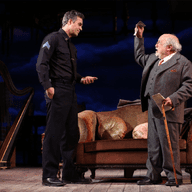
Review: An All-Star Revival of 'The Price' Is Just Right
"The Price" is not gut-punch Arthur Miller. That is, it doesn't leave you eviscerated.
Instead, it's a warmly-wise portrait of a family that is on the edge of getting torn apart forever.
Mark Ruffalo is Victor Franz, the shambling, everyman cop who is trying to sell his deceased parents furniture now that their New York brownstone is being torn down. It's a jumbled mess of stuff from the early part of the 20th century — a bed stand, a library table, cabinets and dressers and chairs.
He and his wife Esther (Jessica Hecht) don't have much money — they're hoping used furniture dealer Gregory Solomon (Danny DeVito, with a wavering accent) will give them a good price. His wife is actually hoping the money will goose Victor's ambition, get him to retire from the force and go back to the science he loves.
There's one problem: the furniture also belongs to Victor's estranged brother Walter (Tony Shalhoub), now a slick surgeon in a camel-hair coat who prizes money above all else. They had a falling out when their father got sick during the Great Depression: Victor chose to stay and take care of him, Walter decided he would get his education (and get out) at any cost.
It's an unexpectedly funny story, thanks to DeVito and Ruffalo's crack comic timing. When it's just the two of them trying to negotiate in the first act, DeVito as Gregory Solomon makes a master comic bit out of eating an egg at just the right (or wrong) time. Ruffalo's Victor follows the 90-year-old dealer around in bewilderment, trying to catch his slippery logic before the money swims out of his hands.
But when Victor enters, it's clear the play is about something other than the cash value of a harp. Its about the cost of the choices we make — and it asks, what's too much to pay?
Miller wrote beautifully, and "The Price" is no exception. There are profound lines here. Solomon, talking about how modern people don't want large, heavy furniture says, "The price of used furniture is nothing but a viewpoint, and if you wouldn't understand the viewpoint, it is impossible to understand the price."
That idea underscores the whole play. Victor and Walter are at odds not because one of them is a bad guy, but because they each paid the price that best aligned with their values. It's a plea for understanding, for empathy, that Miller wrote during the Vietnam War. It still resonates now, in the midst of our own political troubles.
It is easy, the play says, to leave in a huff, to give up. It's harder to try to understand a different point of view.
Roundabout Theatre Company at American Airlines Theatre, 227 W. 42nd St.; through May 7
Written by Arthur Miller; directed by Terry Kinney

WNYC is funded by sponsors and member donations