The Met Finally Welcomes Folk Art to the Premises
“History Refused to Die” is the dramatic title of an appealing but too-tame exhibition that opened this week at the Metropolitan Museum of Art. The show is a landmark — the first to welcome a historically-excluded group of self-taught, African-American artists to the museum. One wonders why it had to be so small. Drawn from a cache of 57 works that were donated to the museum in 2014 by the Souls Grown Deep Foundation in Atlanta, the Met’s exhibition consists of only 30 works, 10 of which are hand-sewn patchwork quilts from the celebrated quilt capital of Gee’s Bend, Alabama.
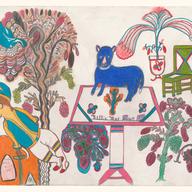
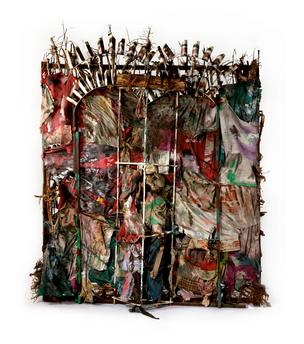
Among the standouts in the show are four drawings by Nellie Mae Rowe, a native of Fayetteville, Georgia who renders her surroundings — a tree, a chair — with an intensity of color that feels almost hallucinogenic. Thornton Dial, a metalworker from Alabama who died in 2016, furnishes the show with its title and theme. His “History Refused to Die,” a 9-foot-tall rectangular sculpture assembled from densely-packed congeries of okra stalks, work clothes and chains, among other found objects, amounts to a kind of American Wailing Wall.
The show is installed in the Met’s 20th Century Wing, in two second-floor galleries adjacent to the Abstract Expressionist galleries. Consequently, you can’t help noticing affinities between them. The work of Dial and his colleagues has many of the qualities — i.e., the monumental scale, rigorous geometry and all-over energy — that distinguish masterpieces of Abstract Expressionism.
On the other hand, most of the pieces in the folk-art show are fairly recent, which has the unfortunate effect of making them seem derivative of Ab Ex, Pop art and other mainstream art movements. For instance, Joe Minter’s “Four Hundred Years of Free Labor,” a metal sculpture welded together from rusty shovels and hoes, has an impressive classicism about it. But when you see the date on the wall label —1995 — you inevitably think that Jim Dine got there first in his tool-based works from the 1960s.
This is a shame, because if the show had been larger, and gone back in a meaningful way to 1940s, it might have demonstrated just the opposite and allowed us to see how folk artists influenced the New York avant-garde. We are normally taught, in Art History 101, that collage and its 3-D offshoot, assemblage, began in Europe, in the art of Picasso and Kurt Schwitters. But what if Robert Rauschenberg, who took assemblage to its pinnacle in New York after World-War II in so-called “combine paintings” that incorporated men’s ties, umbrellas and even a wooden chair, sprang not from Schwitters but from the art of his native South?
Rauschenberg, who grew up in Port Arthur Texas, no doubt owes something to the junk-into art aesthetic that characterizes so much folk art. American art historians have always been stingy about acknowledging black contributions to culture, unless the subject is jazz. But this show raises the possibility that assemblage — a leading style among contemporary artists eager to mix up and mash up their sources — may have originated in the vernacular culture of the South. The Met would be the perfect museum at which to consider that question in another show.

WNYC is funded by sponsors and member donations


