Review: How Not to Handle Your Art Career.
Florine Stettheimer is everyone’s favorite underknown artist. A retrospective of her work opening today at the Jewish Museum is likely to expand her fan club. Stettheimer remains an essential eccentric – an American modernist who flourished in New York during the Jazz Age, painting one-of-a-kind, faux-naïve portraits of her family and her wide circle of artist-friends. But she was unwilling to shoulder the obligations of a career. Disappointed by the reaction to her first show – it was held at the Knoedler Gallery in 1916 – she decided it would be her last. Her deathbed wish, according to her sister Ettie, was that her paintings be destroyed, a request that was fortunately ignored.
Born in 1871 in Rochester, N.Y., into an affluent German-Jewish clan, Stettheimer came from a family that seemed nearly Victorian in its eccentricity. Like the Brontes, or the Henry Jameses, the Stettheimers produced artist-siblings who were deeply enmeshed with each other. Florine, the fourth of five children, remained unmarried and lived for most of her life with two of her sisters and their mother. A hint of sexual repression and arrested childhood seems to characterize their endeavors, and it is telling that Carrie Stettheimer’s grand passion was the construction of a 12-room dollhouse (it’s on permanent view at the Museum of the City of New York).
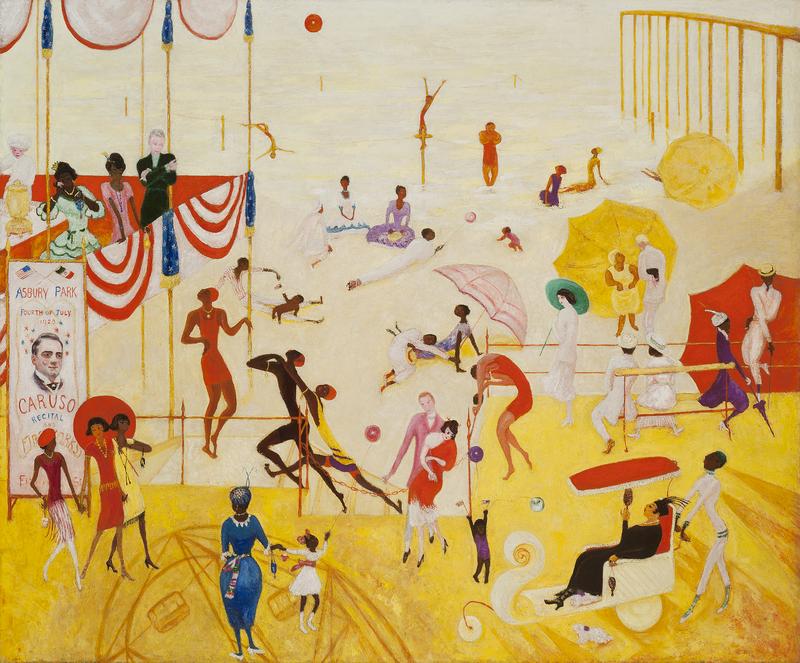
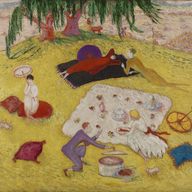
Florine, too, captured pleasures devoid of carnality. Although she studied at the Art Students League and produced a brazenly nude self-portrait in her early years, she went on to cultivate a style of art that can put you in mind of the pictures in children’s books. Can someone please find out which illustrators she admired? Scholars have yet to say. Her subject matter, too, can seem impervious to the onslaught of modernism; her paintings do not refer to agonies of either the romantic or existential sort. Rather, she depicts Christmas trees aglitter with ornaments and July 4th skies streaked with fireworks. She paints beach outings and lazy-daisy afternoons in the country, where tiny figures recline on canopied chairs, savoring a moment of leisure that never ends.
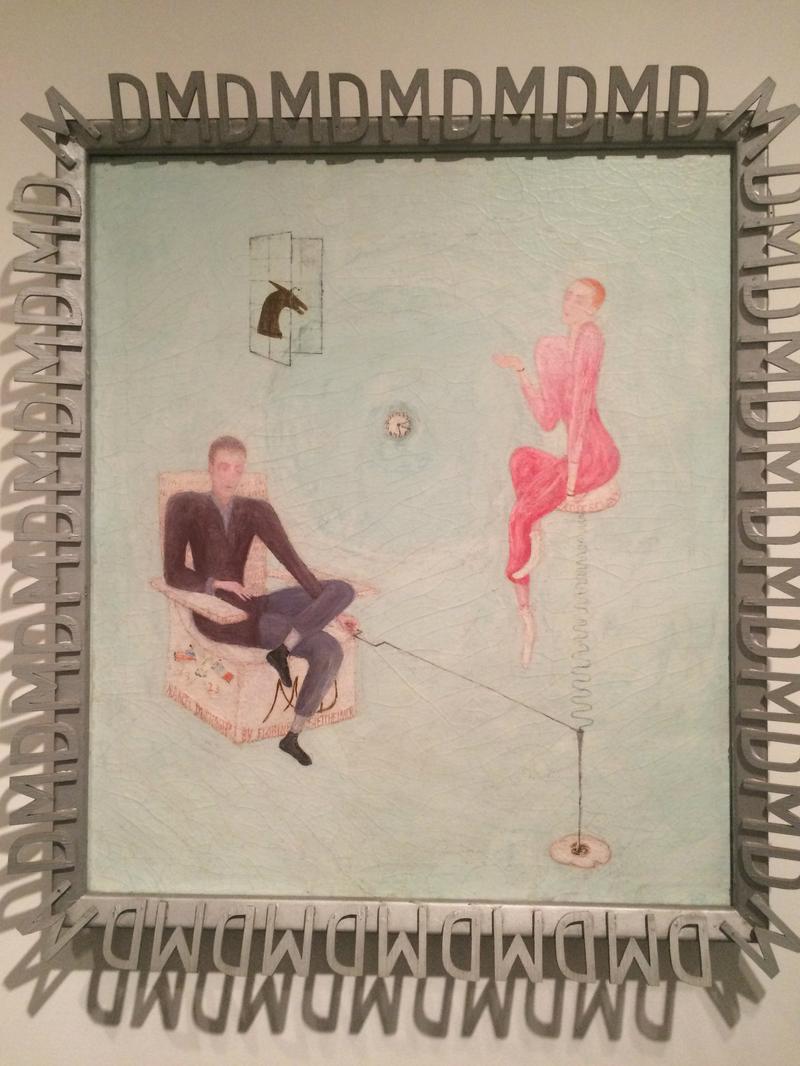
Look for her portrait of her Dadaist-friend Marcel Duchamp, one of the stand-outs in the current show. She depicts him with his female alter-ego, Rrose Selavy, and the painting feels different from her others – sparer, wan, with the stillness of a Surrealist dream. She also made the frame, a clunky and chunky wooden strip composed of Duchamp’s initials repeated all around. It is a reminder that that Stettheimer was dauntingly original and disappointing only in the pointless severity of her criticism of her own work.

WNYC is funded by sponsors and member donations