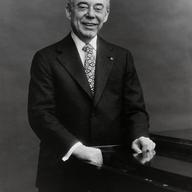
Richard Rodgers
The Douglas P. Cooper Distinguished Contemporaries Collection | Dec 31, 2015
Richard Rodgers was ensconced in his lavish office, at the windowed end of the Rodgers and Hammerstein Organization on Madison Avenue, when he welcomed Douglas Cooper to join him at his circular desk to set up for a career review.
The Interview
Rodgers tells about how he met his first partner, verse writer Lorenz Hart, when they were both at Columbia in 1918. He discovered that Hart was a "genius" creating off-beat lyrics. But after their 1920 Poor Little Ritz Girl was only a demi-success, and the following years found them in the amateur leagues, Rodgers grew depressed. Rodgers tells Cooper that by 1925, he was about to accept a job selling children's underwear, when they delivered an unexpected long run with Garrick Gaeties, introducing a huge hit, Manhattan.
By 1926, the duo had five shows running concurrently on Broadway. One of these was Peggy Ann, which carried an advanced subject matter, Freudian dreams.
In 1929, two of their shows were picked up by Hollywood, leading to a contract to do 8 films on the West Coast. This gave them an opportunity to break barriers again, ending the old "stationary camera" technique.
Their 1936 On Your Toes integrated ballet into the plot. In '38, they did the first Adaptation of Shakespeare on Broadway with Boys from Syracuse.
In 1940, John O'Hara's letter triggered Rodger's interest in the letters of a "hoofer," and a popular show, Pal Joey, was created. Ten years later, in revival, it was the first instance of a re-make being more popular than the original.
By 1943, Larry was both ill and erratic, and Rodgers teamed up with Oscar Hammerstein II for Rodgers’ longest-running hit, Oklahoma! The blend of dialogue, with music that was "of 1900," and of Oklahoma, without being derivative, was unique. Hammerstein coalesced his deep emotionality, romanticism and love of nature.
I asked if the perception were true that the song Bali Ha'i (South Pacific, 1949) was written very quickly. He used this case to exemplify that with each song, he knows the book, he knows the character that's going to sing it. The song must fit the period and story and move the plot ahead, and work with the costuming and every element. It's only that last step of putting the melody on paper that's quick.
When The King and I (1951) was in development, Rodgers tells the story of how he had a better sense of what Siamese music ought to sound like than lifting from a book of songs of that locale and era. We briefly spoke about Flower Drum Song, with the Chinese people and their lives transplanted here.
We talked about three compositions made into television series--Victory at Sea, Cinderella, and The Valiant Years. He explained how, in the first instance, a battleship could be a character in a situation (war) and be enormously moving.
As to new modalities in the theater, Rodgers was open-minded: 'I think if a couple pays $50 for a pair of tickets to watch performers doing dull things, that's a mistake; however, I have nothing against nudity in the theater if it has a genuine purpose, and if it broadens the theater.
_______________________________________________________________________________________________________________
The Douglas P. Cooper Distinguished Contemporaries Collection (1967-1974) contains rare interviews with influential writers, statesmen, artists, songwriters, journalists and others who have left their mark on our culture.
The Origins of The Cooper Collection
Douglas P. Cooper
WNYC is funded by sponsors and member donations