Rocky Graziano
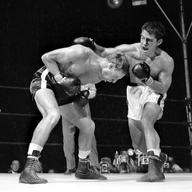
This impromptu meeting with Rocky Graziano, widely considered the greatest knockout artist in the history of boxing, came about when I heard his distinctive "tough-guy" voice at a table behind ours. I knew instantly that it issued from the affable fellow who, for twenty-five years, was a fixture on his own series (and everyone else's), spokesman for restaurants, transmissions (and anything in the Whole Earth Catalog), and that unpredictable guest who might, and typically did, let anything slip. I casually joined him and his referee friend.
The upbeat and gregarious Graziano, having retired from the ring more than twenty year earlier, was holding court at P.J.'s (as many sports legends were wont to do in New York), occasionally breaking off the interview to greet, wave at, or call over to some acquaintance he spotted in the busy eatery's pre-lunch crowd. "Yeah, I come to P.J.'s a lot ... there's a gang of restaurants around here, and I go to each one." The boxer-turned-pitchman was then living "in the heart of New York City," but constantly traveling, doing as many as three or four commercial spots a week around the country for local restaurants, car dealers, and transmission shops, among many others.
The celebrity that boxing brought Graziano paved the way for a second career in front of the camera, often guesting on what might be considered the "second tier" of interview shows—those usually broadcast in daytime. He appeared often on Merv Griffin's program from the Little Theatre in New York, but when Merv moved production to the west coast, Rocky became a regular on the Mike Douglas show, out of the KYW studios in Philadelphia. "Mike's a hell of a guy ... 'Say whatever you want' he tells me, 'but please don't curse 'cause you cost me money!'" Rocky elaborated on all the words you could now say on television that you couldn't before (some of which were so un-"PC" that you couldn't use them now!) He had met and knew several presidents and recounted how the Kennedy brothers often ate at P.J.s in years gone by. "Bob Kennedy used to sit right over here," he gestured.
Among presidents, Rocky was perhaps closest to Nixon, for whom he had campaigned, and who had just been hospitalized with phlebitis the day before this interview took place. Graziano said that he kept himself "in pretty good shape" but admitted that he had been "drinkin' a little bit," so he wasn't ready for a fight, but still well conditioned. in an argument, he said, he would never fight, "or my wife would kill me, 'cause they'd sue me."
On the Foreman-Ali fight then upcoming in Zaire—controversial promotor Don King's so-called "Rumble in the Jungle"—Rocky figured Ali couldn't win, but hoped he could at least keep from being knocked out by Foreman's formidable punches, never expecting that Ali would go on to win by a knockout in the eighth round.
Rocky counted off the great fighters of the past, and reminisced about the weekly grind of regular matches—he had 121 fights in his career ("two or three times" the number of fights current boxers had racked up)—and made several million dollars in the ring.
As for Graziano's schedule of activities, he had just appeared on an episode of Mod Squad, and had been seen on television playing golf with Willie Mays and others just the evening before the interview, and had recently traveled to Covington, Kentucky, and Chattanooga, Tennessee, to record spots for clients.
The former boxer evidenced a good understanding of his role as a celebrity. When thanked for taking time to record the unplanned interview, Rocky perceptively noted that "Without people like you, we'd be out of business."
_______________________________________________________________________________________________________________
The Douglas P. Cooper Distinguished Contemporaries Collection (1967-1974) contains rare interviews with influential writers, statesmen, artists, songwriters, journalists and others who have left their mark on our culture.

WNYC is funded by sponsors and member donations