
Should New Jersey Democratic Officials Keep Jailing Immigrants for ICE?
Democratic officials in North Jersey have long relied on a little noticed source of revenue to keep taxes under control and public workers employed: jailing immigrants. But now that President Trump has expanded the scope of Immigration and Customs Enforcement, sending more than 1,900 immigrants into county jails in Hudson, Essex and Bergen counties, an increasingly vocal movement is growing within the Democratic party to pull out of the immigration detention business.
In Hudson County, about 630 men and 30 women arrested by ICE in New York City now make up the majority of all inmates at the county correctional facility. The $120 daily fee for each detained immigrant translates into enough revenue to save county taxpayers more than $11 million, officials said. If the contract was scrapped, they said about 100 corrections officers at the jail would lose their jobs.
That's the crux of why Anthony Vainieri, the Democratic chairman of the board of freeholders and the top county legislator in Hudson, wants to keep ICE's money flowing. In an unscheduled vote last month, the freeholders renewed Hudson County's deal with ICE, which could pull in $35 million annually for an indefinite time period. The vote was 5-2.
"We’re going to be hurting our own" if the contract were to be cancelled, Vainieri said after a tour of the jail last week. "We’re going to be hurting our own staff, and we're going to be hurting our own county families. That's the bottom line."
But many Democrats disagree. An internal Democratic feud has broken out over the decision, with two county freeholders, the entire city council in Hoboken and a pair of prominent mayors blasting Vainieri and his allies, saying they're choosing money over morality by fueling President Trump's deportation machine.
"The fiscal argument in and of itself is highly offensive to me because you can't reduce human lives to dollars and cents," said Hoboken Mayor Ravi Bhalla. The City Council recently approved a non-binding resolution to demand the county pull out of its deal with ICE. "We’re a country that's based upon immigration, we're a country that was built on the backs of immigrants, and it's part of our core value as Americans to be welcoming of immigration and immigrants."
Referring to the fact that some at the Hudson jail are held solely on an immigration violation, which is a civil infraction, Bhalla added: "We should not be doing business with the Trump Administration in a manner that enables and enforces draconian immigration policies which separates families at the border, and which detains people who have committed no crimes."
If Hudson cuts ties with ICE, Bhalla reasons, it will force Essex and Bergen to do the same. Other publicly-run jails elsewhere in the country have already ended their arrangements with ICE.
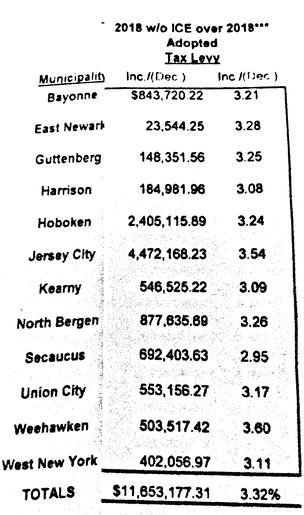
Yet Hoboken stands to see a $2.3 million spike in its share of the county tax levy if the ICE contract is killed, according to a county analysis provided to WNYC. Jersey City, where Mayor Steve Fulop also vociferously opposes the contract, would have to pay nearly $4.5 million more.
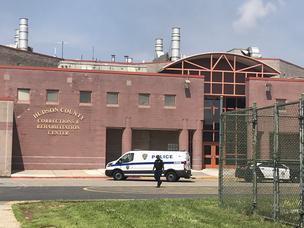
Opposition to the ICE arrangement in Hudson County, where 43 percent of the population is foreign born, grew after six inmates at the jail died over a recent nine-month period. A recent Saturday protest outside Hudson's jail in Kearney was so loud that the chants of "libertad" seeped inside its walls and "almost caused a riot" in one of the wings where immigrants are held, according to jail director Ron Edwards.
"It’s a touchy situation, without a doubt," Vainieri said. "I feel for the families that are being broken up, without a doubt. I have a family myself and I would never want to see it done to anybody in any situation...But unfortunately this is what the president is doing to us. And it's horrible."
Can Democrats continue using anti-Trump rhetoric while deflecting criticism from the grassroots that they're acting as Trump's immigration enforcers? That's a looming question as the amount of money the three Democratic counties in New Jersey collected from ICE skyrockets — up 46 percent from January 2015 to March 2018.
The controversy is also playing out in Essex, which collects nearly $3 million per month on its 780 detainees, and Bergen, where 483 immigrants are now being held for about $1.1 million per month.
At a recent Essex County freeholder meeting, audience members chanted at the Democratic board members: "Which side are you on?" In June, eight protesters were arrested blocking an entrance to the county office building and demanding a meeting with Joseph DiVincenzo, the county executive.
"My job is to keep taxes at a minimum and to bring in revenue," DiVincenzo said before officials gave WNYC a tour of the Essex County Correctional Facility last week. "We're doing it because someone has to do it, and we know we can do it better than anyone else."
Asked about whether he was sidelining moral ideals for cash, he scoffed. "It's absurd," DiVincenzo said. "We're doing our job here. It's the law. And whatever immigrants we have here we're treating with care."
The controversy is less driven by how the immigrants are treated and more by what kind of immigrant is detained in these facilities. That's because Trump altered the mission of ICE, so more of those without criminal convictions — but with civil immigration violations — end up detained. Arrests of undocumented immigrants with no criminal record increased 203 percent in the first 14 months of the Trump Administration compared to the last 14 months of the Obama Administration.
Trump's expanded approach to immigration enforcement is coinciding with another seismic change in local criminal justice operations in New Jersey: bail reform, including a law signed by former Gov. Chris Christie diverting low-level drug offenders away from jail and into treatment. Bail reform has resulted in a dramatic drop in inmates throughout the state. The pre-trial jail population plummeted 24 percent between January 2017, when the state's law went into effect, and April 2018, according to the ACLU of New Jersey.
Simply put, New Jersey jails have a lot of empty beds. And immigrants are now filling the bunks where local marijuana dealers once slept, waiting days, months and sometimes years for their pending deportation proceedings to wind their way through a backlogged immigration system.
In Bergen County, bail reform has led to a 37 percent decrease in regular county inmates, and ICE detainees have taken their place. But Sheriff Michael Saudino, an elected Democrat and former Republican who runs the jail, said his primary reason for keeping ICE detainees is public safety — not revenue.
"My concern more than the money aspect is: Who are we releasing out to the general public again?" Saudino said. "My concern is public safety, okay? And there are some people here, even ICE detainees, that I personally couldn't see wanting them back out on the streets." Saudino said that nearly half of the ICE detainees held at Bergen County Jail previously served time for serious crimes, and he sees it as his obligation as an officer to cooperate with all other law enforcement agencies.

Earlier this year, activists were successful in pushing Hudson County to pull out of a so-called 287(g) contract, in which corrections officers worked with ICE to flag undocumented inmates. But when it comes to detention, the stakes are higher: Hudson County increasingly relies on revenue from ICE to keep taxes under control and prevent layoffs of its unionized corrections officers, many of whom, according to officials, are county residents, women and people of color.
One argument for maintaining the ICE contract is it's convenient for the locked-up immigrants who live in the area to get visits from their attorneys and loved ones. Hudson and Bergen house immigrants for ICE's New York's office; Essex detains those picked up in New Jersey.
The most high-profile immigrant to recently spend time at Hudson's jail is the Ecuadorian father arrested while delivering a pizza to the Fort Hamilton Military Base in Brooklyn. After being released last month, he called the conditions there "inhumane."
"We had to clean the place from residuals of urine and feces, and there was no air conditioning," Pablo Villavicencio told The Daily News. "It was very difficult."
Detainees are paid in these facilities to work in the kitchen, laundry and bathrooms. They get between $1 and $1.50 per shift.
WNYC was given a tour of the Hudson jail last week. Photographs and recordings were not allowed inside. Immigrant detainees were housed separately from regular county inmates, but they lived under the same restrictions. They wore a mix of grey sweatpants and t-shirts, and orange jumpsuits. They were allowed half-hour visits from family, but only on Saturdays could they touch — or hug — their children and loved ones. They could use email, but jail officials said their communications are monitored for gang activity and pornographic material.
Corrections officers regularly use pepper spray to control immigrant detainees, according to Use Of Force reports provided to WNYC through a public records request. Twenty-five inmates were exposed on the afternoon of March 26, but officials said all were medically cleared and unharmed.
Hudson County Correctional Facility, Use of Force reports for immigrant detainees, January to April 2018 by mattkatz on Scribd
Edwards, the jail director, also said restraint chairs are occasionally used for unruly detainees. And detainees who cause problems are sent to restricted housing, where they stay in a cell for 22 hours a day.
Some ICE detainees are housed in two-man cells, but those deemed to have the least security risk live in large rooms with 32 bunk beds stacked close together. During the visit to one unit last week, two TVs were tuned to Telemundo and MSNBC, but no one was watching. Most of the men were still in bed, many with their heads under the covers to block noise and glaring lights. It was 10 a.m.
Officials explained that some may have worked overnight shifts. But detainees also said they just didn't have anything to do. A small triangular room with a fence that allows in fresh air from the outside, known as "the cage," had an exercise bar inside. Real soccer balls aren't allowed, out of concern that they could break the window overlooking the unit. Foam balls suffice.
There is a yard for outside daily recreation, but the detainees are only allowed out if the unit is clean and no one commits an "infraction," according to Edwards.
One former detainee who spent almost a year-and-a-half at Hudson on an immigration violation said inmates can play basketball and soccer in that outdoor yard for one hour on most days. "It's fresh air, you're in the sun, and you can get to relax," he said. "It's like you’re outside for a moment." But the former inmate, who asked that his name not be used because his case is still pending, said outside recreation was regularly cancelled when there weren't enough officers on duty, like during the holidays.
During the tour last week Ravin and Ashwin Bhola, two brothers from Queens originally from Suriname, South America, were spotted in their dormitory unit playing a board game — with no board. They used a marked-up bedsheet in lieu of a board. Edwards, the jail director, explained that detainees sometimes try to smoke cardboard laced with roach killer to get high, so board games aren't allowed in the unit.
He also alleged that "certain cultures put game pieces in their body for euphoria." That's why checkers and chess boards were used elsewhere in the jail, he said, but were forbidden in the immigration dorms.
Ravin Bhola, who works at a car wash, said he was charged with a crime and had a scheduled court date earlier this month. But on the morning of his hearing ICE agents came to his apartment in Hollis and arrested him along with two brothers and an uncle — none of whom had charges beyond overstaying their visas. All four were taken to Hudson County Correctional Facility, but they were not housed together in the same dorm.
Hudson Freeholder Bill O'Dea, a Democrat, was on the tour and met the Bhola brothers. He had previously voted against renewing the ICE contract. In front of the detainees, he told jail officials that it was "embarrassing" to find a board game made from a bedsheet.
"Was it clean? Yes," O'Dea said of the jail. "Was it safe? It appeared definitely to be safe. But what was the life like? There was nothing for the individuals there to do. There was no real recreation. There were no activities."
O'Dea wants to phase out of the ICE contract over the next year or two. But in the meantime, he proposes to redirect as much as $4 million in profits from the ICE contract to ensure that every detainee from Hudson County has a lawyer — and something to do all day, like educational and recreational programs.
The plan could come up at the next Hudson freeholder meeting on Sept. 11. Last week Vainieri and the majority of the Democrats on the board voted against moving the gathering to a larger space to accommodate the crowds of opponents expected to be there.
Not all pro-immigrant activists want to immediately kill the contract with ICE. They are torn between concentrating their energies on working to improve life inside the jail or ending a contract that won't necessarily have the larger effect of altering federal immigration policy.
"It's a big dilemma that we have," said Sally Pillay, program director of First Friends of New York and New Jersey, which is piloting a program to bring yoga and arts programing into the Hudson jail. "I think the end goal is to end all the contracts, but in the meantime: Make the conditions better and call for more transparency."
Part of transparency involves access into the facility. And to that end, freeholders and two reporters on last week's tour were able to talk to inmates who complained about the quality, quantity and variety of food served to inmates. Dinner is delivered to housing units early, at 4:30 p.m., and inmates say they have to pay for commissary items to supplement their meals. They also complained that their last complaints to visiting freeholders, back in October, yielded no changes.
"You promised there'd be better food, I remember that," said Victor Rodriguez, who was detained by ICE 16 months ago as he was bringing his kids home from school. Originally from the Dominican Republic, he said he lived in the U.S. for 33 years and previously served time for an attempted murder charge in 1993.
Edwards denied that the food was poor. "We do ensure that it's nutritious, that it's sanitary," he said. He added that he tries to run a top-notch facility. "We don't try to be the best in the state — we try to be the best globally."
But Hudson's jail has had problems beyond the food. Immigrant advocates found that 121 medical grievances were filed by immigrant detainees from January 2014 to the beginning of 2016. And from June 2017 to last March, six inmates died there — including an immigrant, Carlos Mejia-Bonilla, whose family said he wasn’t treated for a medical condition. A lawsuit is now being filed on behalf of his daughter.
On the medical front, changes are afoot. The county is now replacing its medical contractor. And during the tour, Edwards showed off a new medical wing, under construction. The medical unit will feature more cameras, a larger female infirmary, dialysis machines and detox treatment for opioid addicts. A style of bedpost which had been used for suicide by hanging will be replaced.
Still, issues have recently been cited by a variety of inspectors:
-
The Department of Homeland Security inspector alleged last December that the jail lacks provisions like soap and toilet paper.
- Human Rights First reported a lack of sanitary pads for women, a case of verbal assault from a female officer and an instance of a detainee forced to use a bra as a sling for a clavicle fracture.
- A 2017 ICE inspection report showed 22 deficiencies, including the dangerous use of pepper spray to suppress inmates.
Jail officials said they have addressed all issues raised by both detainees and outside investigators. And when Vainieri asked a group of inmates if they'd rather be here than elsewhere in the country, they all said they wanted to stay in Hudson — close to relatives and attorneys, for those who have them. That’s reason enough to keep the contract, he said.
"We would prefer [to be] here," said Rickey Roberts, 58, a real estate broker from Antigua who lived in Valley Stream, N.Y., before being detained.
"I rest my case," Vainieri said. "I'm done."
Vainieri said as long as immigrants are being picked up by ICE, Hudson County has a duty to treat them well. He said the jail is clean, the staff is professional and the food is "nutritious and includes protein." He also said that substance abuse treatment, dental and vision care, and "very good general medical treatment" is provided.
"They’d be shipped to Montana or Texas where they’re not gonna care about the inmates from the area because they’re not gonna have the families outside ringing the doorbell saying, 'Hey my son's in there, my father's in there, my mother's in there, help her,'" he said.
The immigrant who previously spent 18 months at Hudson said for those like him, family visitation doesn't matter. He has no family in America. He served time on a separate federal criminal charge for a few months before being transferred to Hudson on immigration violations.
"The only difference between federal [prison] and immigration [detention] is the food. You get better food in the federal," said the immigrant, who is out on bail while his case is pending, so he didn't want his name used. "I don’t want to say it’s hell....[But] you’re told what to do constantly throughout the day."
Not hell, but jail. Locked up, just like any other prisoner. And for those Democrats who don’t think undocumented immigrants are criminals who need to be penned in all day, that's exactly the problem.

WNYC is funded by sponsors and member donations