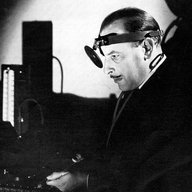
Sir Cedric Hardwicke Reflects
"What business does an actor have writing a book?" the venerable star of stage and screen asks at this 1961 Book and Authors Luncheon. His memoir, A Victorian in Orbit, came about because of an unusual offer. A friend working at a newspaper offered to let Hardwicke have a sneak peek at his already prepared obituary. The article, Hardwicke declares, was "deadly dull." He decided to have his say on his life while was still capable of doing so. He then tells a deceptively simple anecdote which illustrates the underlying thought of both his book and this talk: Sir Henry Irving was acting in a scene that took place in a dungeon. The one barred window let in a spill of green limelight. Someone asked why there was green light in a dungeon. "This is not a dungeon, it's a theater!" Irving replied.
Hardwicke makes a plea for more magic, more "gaiety and glamor" in today's unrelentingly "realistic" theater. Although pundits claim the theater has been dying for fifty years, it is now, he warns, threatening to commit suicide. Why? Because it is "moving away from the people." Despite this rather backward-looking message, he does not come across as a hidebound reactionary. His is a more wistful lament, and also the sounding of genuine alarm for the fate of a community that obviously means a great deal to him. Hardwicke's remarks are brief and he seems to be suffering from a cold, but one can still revel in the beautifully clean diction and crisp tone of a great, classically trained British actor.
Sir Cedric Hardwicke (1893-1964) was the ultimate professional, with a career encompassing both the London and New York stages, Hollywood, radio dramas, and spoken word recordings. The British Film Institute, surveying his achievement, concludes:
The main film career of this illustrious film character actor belongs to Hollywood, where he first went in 1934, and returned in the late 1930s, staying to play dozens of dignified persons, sometimes villainous, occasionally benign, at times imperious. From 1912, after RADA training, he had a very long and distinguished stage career in London and New York, excelling as an interpreter of Shaw. He was knighted in 1934…."Intimidating" was perhaps what he did best, but the range is wide and the pickings rich: he was apparently always short of cash which was bad luck for him but not for filmgoers as it meant he played over 80 roles with consummate authority.
Although Hardwicke is remembered now mostly as a character actor, he introduced many of George Bernard Shaw's works and toured the United States in a "concert version" of Don Juan in Hell. In reviewing this memoir when it appeared, New York Times theater critic Brooks Atkinson pointed out:
In general, Sir Cedric regrets that magic has gone out of the theater. It would be impossible not to agree with him. But his comments present a dilemma rather than a solution; and as he realizes, involved him in a paradoxical situation. For Shaw has been the most decisive influence in his career, and it was Shaw, more than any other dramatist, who destroyed the old romantic theater in favor of the theater of ideas. …In the modern theater, the size that Sir Cedric remembers from his apprentice days can only come from a dramatist of size. No matter how small the scale of living may be, a dramatist with a powerful imagination can transmute it into a great audience experience.
Perhaps this reverential nostalgia is just another part for the then sixty-eight-year-old actor to assume. There is a playfulness to Hardwicke's complaint that makes one suspect that he is "trying it on for size." In its obituary, the Tuscaloosa News paints a more relaxed portrait:
During an interview, the neat and precisely spoken actor complained of a public misperception of him as a "dignified, stuffy prig, whereas by nature and training I really am a clown, and started out to be a clown."
Shaw may have sensed this as well. The playwright is reported to have told Hardwicke he was his fourth favorite actor. The first three were the Marx Brothers.
Audio courtesy of the NYC Municipal Archives WNYC Collection.
WNYC archives id: 71193
Municipal archives id: LT9252

WNYC is funded by sponsors and member donations