The Story Behind the V.D. Radio Project
You’re right, Dr. Barnouw. The idea of the future leader of the free world, perched in his new aerie atop the ivory towers of Columbia University, listening with sincere attentiveness to a syrupy, organ-drenched melodrama about the great unspeakable anathema of syphilis, is bizarre, even ridiculous.
In 1948, Erik Barnouw was already a respected broadcast radio pioneer and eminent scholar, the kind of man one would expect to become the future author of a classic three-part history of Broadcast Radio. And he was. But if you told him then that a year later that he would coauthor—as a man of no known musical pedigree, just now digging his fresh heels into the roots of ivied academia—the can’t-be-real-but-it-is venereal disease honky-tonk juke box smash, “The Ignorant, Ignorant Cowboy,” while holding the helm of the creative team of a nationwide public health campaign aiming to stop the scourge of syphilis, I’d imagine he would have had quite a laugh.
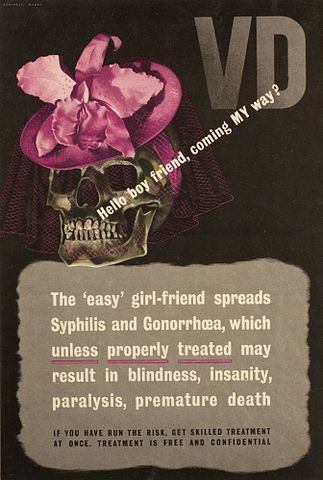
It’s hard to not view the whole thing as being pretty silly. Part of the reason for that stems from the way the creators of the V. D. Radio Project chose to handle it. Syphilis was so untouchable you had to dance around it, make a play of it. Keep your haha distance. Keep it light. It was the only way to reach people, and there were an estimated 3 million Americans in 1949 who carried the disease and needed treatment. Treatment without fear and shame.
A couple of years ago our colleagues at Studio 360 aired an episode on the VD Radio Project, entitled “VD on the Radio.” We encourage you to give it a listen - it’s as good an overview of the story as you’ll find (Barnouw’s own Media Marathon is excellent overview as well, and we’ve written our own below). But given their difficulties finding Roy Acuff’s contribution in any archives (we sympathize), we thought we’d lend the world a hand and clear ours out. And lo-and-behold there he is.
Included here is our collection of recordings from the V. D. Radio Project, pulled from a variety of sources - Columbia University, the NYC Municipal Archives, and, particularly, the National Archives and Records Administration. Our collection includes promos and PSAs from media stars like Ed Sullivan and Tex and Jinx to politicians like Ike and Adam Clayton Powell. We've got Barnouw’s hit song; interviews with doctors and patients; and of course the crown jewel - hours upon hours of (slightly) goofy radio melodramas: some of them have cowboy songs, others have a Lomax (Alan) or a Fonda (Henry). But all of them have syphilis... But, not, you know, like that.
A Short History of the VD Radio Project
In 1943, Dr. John Friend Mahoney cured four patients of syphilis using a then-new treatment, penicillin, shortening what was a long and painful process, seldom followed through the full 18 months to completion, into a week’s worth of trips to the doctor and a handful of shots in the arm.
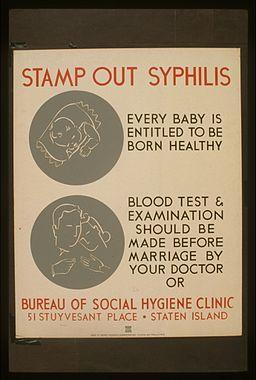
Earlier public health campaigns aiming to end syphilis, like the one pictured at right, had mostly foundered on the fact that the comparatively mild early symptoms of syphilis seemed to disappear of their own accord (or due to some dubious tincture) without the pain and suffering of the then prevalent treatment, leaving the men and women who carried the disease to ignore at their peril the disease's far more damaging late stage effects. For public health advocates, a quick and painless cure like penicillin was a godsend.
As the war was winding down, Congress passed the Public Health Service Act of 1944, which allowed the PHS to create and pursue aggressive campaigns which would attempt to draw in millions of men and women carrying the sexually transmitted disease for the new and simple treatment. It was under this influx of congressional funds that the PHS’ Lefoy Richman, recalling the Radio Act of 1927’s mandate that radio would serve the public interest, contacted Columbia University professor Erik Barnouw in 1948 to see if his university might be interested in bidding on the opportunity to produce programs that might convince people to seek treatment. Richman, in fact, had pursued dozens of universities with the same offer but hoped the Ivy League's Lions would consider as well.
Columbia was the only bidder.
Barnouw moved quickly, enlisting top talent, using his connections from his NBC days, his newly-minted role as president of the Radio Writers Guild, and his Columbia University professorship to draw the finest writers, actors, and producers in the business. Under Barnouw’s stewardship, the VD Radio Project (as it was now called) devised a multi-pronged attack, creating a variety of programming aiming to draw in those suffering from syphilis.
To bring their programs to the air, Barnouw, Richman, and the VD Radio Project team initially sought out individual stations, but found no takers, with station managers fearing reprisals from the Catholic Church and other powerful organizations who would see the programs as an invitation to licentiousness. So they tried the networks, and after receiving a firm “no” from both NBC and CBS finally convinced ABC to give them a chance. Their first recording, “VD: The Conspiracy of Silence,” (sadly, not part of our collection) aired April 29, 1948, to wide acclaim.
The VD Radio Project also prepared local drives, the first of which was in Jackson, Tennessee. In Jackson, each and every local station carried their programming, which they hoped, combined with planned print and billboard campaigns, would bring in new patients. Barnouw and his team had developed a variety of material - standard-issue soaps, short spots featuring politicians and entertainers, and patient and doctor interviews - but the biggest response came from the three “hillbilly operas” they had prepared for broadcast. The so-called hillbilly operas were famed folklorist Alan Lomax’s idea; He even wrote a few scripts. The programs featured folk, country, and gospel superstars performing their songs in stories tailor-made for their tunes and talents, mini-operettas of meet cute, meet syphilis, meet cure. Needless to say, when they learned of their success, the PHS quickly commissioned more. Hank Williams, Roy Acuff, Sister Rosetta Tharpe and many more cut fifteen-minute melodramas specially made to fit their songs and styles, as well as the PHS’ target markets - the rural south and industrial north. Barnouw even found time to pen a jukebox hit, “The Ignorant, Ignorant Cowboy,” at the suggestion of a health officer from the Tennessee drive.
The VD Radio Project was a huge success—according to Barnouw, the Tennessee Health Department reported that in 1949, over 18,000 cases had been drawn to seek treatment by the programs—but it was a short-lived one. In 1953, in one of the first acts of his administration, President Eisenhower, ironically an early champion of the project during his time at Columbia University, discontinued the project. In an additional irony, the variety of diseases that came to be treated by penicillin, and that no longer required as diligent a diagnosis, when combined with the development of technique by which a single dose could cure the disease had the unfortunate effect of making contact tracing, in which people infected by the disease could lead to others, virtually disappear. The disease came roaring back. The cure was too successful. Still, while it lasted, the VD Radio Project was proof of the efficacy of public health radio programs, and helped removed some of the stigma surrounding the treacherous, but curable, disease.
Notes on the Arrangement
In Media Marathon, Erik Barnouw mentioned four types of programming created by the VD Radio Project: soap operas, "documentar[ies]" (i.e. interviews with patients), short spots, and "hillbilly operas."
For this page, we've grouped the two "operas" together under Radio Plays+. The vast majority are of the "hillbilly" variety, but they're all interesting and enjoyable in their own right. The first item (the "+") is Tom Glazer's Erik Barnouw-penned hit single "That Ignorant, Ignorant Cowboy." Principle contributors to the various programs are included in the title.
Celeb Spots includes short advertisements from famous politicians, entertainers, and doctors urging treatment. All of the Interviews we hold in this collection are on a single track. It features Dr. George Hicks making the rounds with men and women suffering from syphilis, at various stages. And we have two Oral Histories with VD Radio Project head Erik Barnouw, one done by Columbia University, the other done by WNYC Archives Director, Andy Lanset, rounding out our collection.

WNYC is funded by sponsors and member donations