Tropical storm Ophelia puts patch of North Carolina under hurricane watch
Tropical storm Ophelia has strengthened ahead of its expected arrival on the coast of North Carolina early Saturday, pushing out near-hurricane force winds. The storm is forecast to bring high gusts, coastal flooding and life-threatening rip currents northward to New Jersey over the weekend.
After the storm's maximum sustained winds increased to almost 70 mph with higher gusts, the National Hurricane Center issued a hurricane watch from north of Surf City to Ocracoke Inlet in North Carolina, a roughly 130-mile stretch.
Forecasters said they didn't expect the storm to further strengthen before landfall through the rest of the weekend — it's instead likely to weaken after landfall, the center said. But they're also not counting out that risk.
"Some additional strengthening cannot be ruled out as Ophelia traverses the warm waters of the Gulf Stream on its approach to eastern North Carolina," the NHC said in a 8 p.m. ET update on Friday. "While this does not seem like the most likely outcome and is not explicitly forecast, the increased risk warrants the issuance of a Hurricane Watch."
A tropical storm warning remains in effect from Cape Fear, N.C., to Fenwick Island, Del. This includes Albemarle and Pamlico sounds in North Carolina, the Tidal Potomac River south of Cobb Island, Md., and Chesapeake Bay south of North Beach, Md. The region stretching from Surf City to Bogue Inlet in North Carolina, and the remainder of Pamlico and Albemarle Sounds, were under a storm surge watch. A storm surge warning was also in effect from Bogue Inlet, N.C., to Chincoteague, Va., in Chesapeake Bay south of Colonial Beach, Va., the Neuse and Pamlico rivers and parts of Pamlico and Albemarle sounds.
Between 3 to 5 inches of rainfall is expected across parts of eastern North Carolina and southeast Virginia into Saturday, with as much as 7 inches falling in some areas. The Mid-Atlantic into southern New England, is forecast to get 2 to 4 inches of rainfall from late Friday into Sunday, which could create flash, urban and small stream flooding, forecasters said. Southern New York through southern New England could get 1 to 3 inches from Saturday to Monday.
Floodwaters on the North Carolina coast could reach 6 feet
The swells generated by Ophelia are likely to cause life-threatening surf and rip current conditions across the Mid-Atlantic coastline.
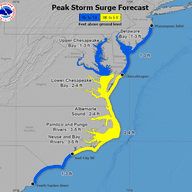
Areas stretching from Surf City N.C., to Chincoteague, Va., could see flooding of 2 to 4 feet if the storm surge peaks along with high tide, forecasters said.
Flooding risks to coastal stretches hemmed in by the Outer Banks are of particular concern, with the Neuse and Bay rivers and the Pamlico and Pungo rivers expected to see floodwaters rise between 4 and 6 feet.
The surge could cause flooding of 2 to 4 feet in the lower Chesapeake Bay and 1 to 3 feet farther up the bay.
Floods are getting more frequent and severe in most of the U.S. because of more extreme precipitation and sea level rise from climate change.
The storm picked up speed as it was upgraded on Friday afternoon from a "Potential Tropical Cyclone 16," as the NHC terms it, to a tropical storm. As of Friday evening, Ophelia was moving 12 mph while about 70 miles southeast of Cape Fear.
As it continues plotting a northerly path, the NHC said the storm will move across eastern North Carolina, southeastern Virginia, and the Delmarva Peninsula on Saturday and Sunday.
A few tornadoes are possible Friday and Saturday in the mid-Atlantic states, the NHC said.
North Carolina Gov. Roy Cooper and the state's department of public safety urged residents across eastern and central portions of the state to be prepared for tropical weather over the next couple of days. Warning of the potential for downed trees, power outages and flooding, the officials also encouraged people to stay tuned to the latest weather forecasts.
"As tropical weather is threatening our state again, we are reminded of the importance of being prepared by having a family emergency plan and kit," Gov. Cooper said in a statement Thursday.
North Carolina Emergency Management director Will Ray said the department is prepared to provide needed resources.
9(MDEwODYxNTQyMDEzNjAxODk2Nzc2NzNmYQ001))

WNYC is funded by sponsors and member donations