Trump's Announcement He Won't Go to Israel Is Met with Sigh of Relief
After Israel’s prime minister rejected Donald Trump’s call to ban Muslims, the Republican presidential nominee cancelled his trip to Israel in a tweet.
I have decided to postpone my trip to Israel and to schedule my meeting with @Netanyahu at a later date after I become President of the U.S.
— Donald J. Trump (@realDonaldTrump) December 10, 2015
"I believe Mr. Trump has gone too far — clearly too far," said Morton Klein, president of the conservative group, the Zionist Organization of America.
The group does favor a more limited ban on Muslims coming to the US from countries where ISIS has a major presence. But Trump’s call for a ban on all Muslims has put even conservative hawks, like Benjamin Natanyahu or Klein, in a tough spot.
It’s become standard practice for Israel’s Prime Minister to meet with American presidential candidates who request a meeting. But Trump's extremist views on Muslims were bound to cause problems for Netanyahu if he had stuck with his plan to visit.
“Oh I’m sure everyone was greatly relieved,” says professor Ronald Zweig, a professor of Israeli studies at New York University. "Donald Trump is a rogue cannon, He may embarrass everyone, and he may drag Netanyahu to extreme positions."
Closer to home, however, those coming to an event for Pennsylvania Republicans held at New York City's Plaza Hotel said Trump has a lot of support, even for his call to ban Muslims. "The overwhelming majority of the Republicans support Donald Trump's moratorium on the on the importation of migrants from Muslim countries, said Republican Marc Scaringi from Pennsylvania.
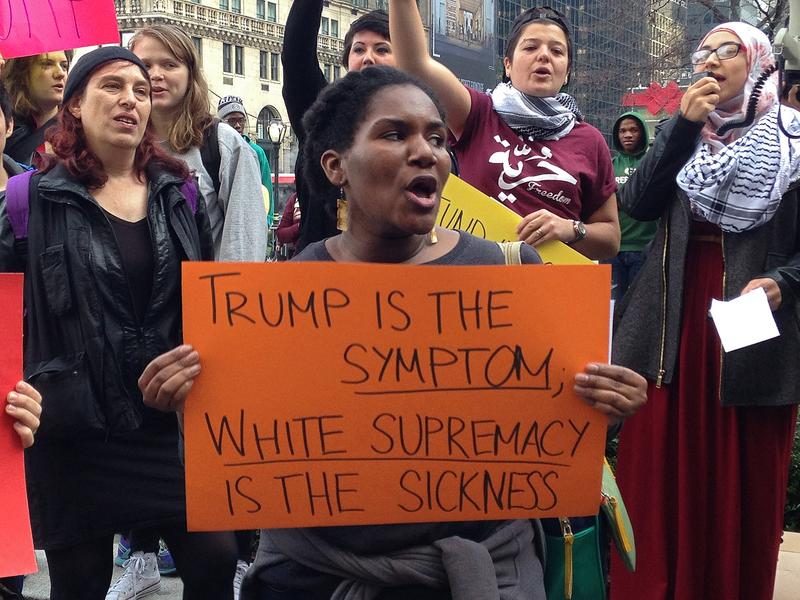
Hundreds protested Trump outside the event and about a dozen activists burst into the luncheon before being quickly thrown out. Other protesters bought their way in. Jennifer Hirsch, a Columbia University professor and a member of Jews for Racial and Economic Justice paid $1,000 for a ticket to protest Trump. "Let's call it what it is, let's call it fascist fear-mongering," she said. "I feel a duty as a Jew, as a citizen, to speak up and say, this could have been my grandparents in Germany. Now is a moment when we cannot be silent."

WNYC is funded by sponsors and member donations