Twenty Years Later: The Police Assault on Abner Louima and What it Means
On August 9, 1997, police officers took Haitian immigrant Abner Louima — after yanking his pants down to his knee — in the bathroom of the 70th precinct in Brooklyn. There, Officer Justin Volpe used a broken broomstick to sexually assault the handcuffed man. Word of the attack shocked the city, and Louima would eventually testify in a federal trial that sent two officers to prison.
But today, many young New Yorkers don’t know about the case. Sitting outside a restaurant in downtown Brooklyn, 18-year-old Christopher Watson said he had not heard of Louima, though he could name others who died, like Michael Brown and Sandra Bland. "Those are the recent ones I heard," he said.
When we approached older New Yorkers, some initially confused Louima with Amadou Diallo. He was the West African immigrant who was shot 41 times in 1999 by Bronx police officers who mistakenly thought he was pulling a gun out of his pocket instead of a wallet.
"This was the young man shot in the back or something," said Ali Lamont, Jr., who struggled to recall Louima.
A Rare Case of Cops Held Accountable
The assault on Louima in 1997 was a major event in the city’s history. It shone a harsh light on police and community relations, which were already fraught. And fallout from the case is still being felt today. Jimmie Briggs, a writer and oral historian, said Louima deserves more attention.
"I have no hesitation in saying I think what happened to him and to so many other people in this country’s history, in this city’s history, was a part of the emergence of Black Lives Matter," he said.
Briggs is currently working on an oral history of the police shooting of Michael Brown in Ferguson, Missouri. He said the Louima case is loaded with symbolism.
"I think about the emasculation of manhood, but the emasculation of a black man, specifically," he explained. "And the fact that somehow, miraculously, Mr. Louima survived and was able to talk about it and bear witness to it, for me just makes it so important that we honor not just the 20th anniversary but moving forward, as well."
He noted that the Louima case was one of the few times a victim of police brutality lived to tell his tale and got a jury to convict police officers. But at first, that didn’t look like an easy feat.
The Night Of
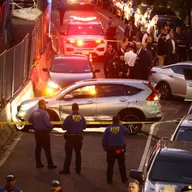
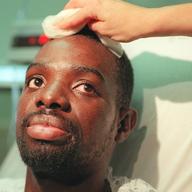
In the predawn hours of August 9, 1997, Abner Louima was leaving the Club Rendez Vous nightclub in East Flatbush. Police officers were breaking up a crowd in the street when somebody punched Officer Volpe in the face. Volpe mistook the assailant for Louima, a 30-year-old security guard. Officers on the scene arrested Louima and took him by squad car to the 70th precinct. Later, he said an officer brought him to the bathroom and held him down while Volpe sodomized him with a stick. He was left bleeding on the floor of a cell, and spent two months in a hospital after surgery for his internal injuries.
At first, the story seemed too sadistic and violent to have been carried out by officers sworn to uphold the law. And the police union staunchly defended the officers accused of the attack. Marvyn Kornberg, the attorney for Volpe, even outrageously claimed Louima's injuries were caused by rough gay sex in a nightclub.
But many people of color found the story all too believable. That year, then-Mayor Rudolph Giuliani was running for re-election on his campaign of law and order. But blacks and Latinos were chafing at the rising number of stops and frisks in certain neighborhoods. The acquittal of a Bronx police officer in the 1994 death of Anthony Baez, and the 1992 acquittal of police officers in Los Angeles charged with beating Rodney King, were also fresh on the minds of many residents. Two protests were held the same month of the Louima attack, which became known as the "police torture case."

'Are You Sure This Happened?'
Charles Campisi was head of the NYPD’s Internal Affairs Bureau at the time. He said a lot of high-ranking people in law enforcement were shocked by Louima’s allegations at first, including the mayor. He recalled going to City Hall and breaking the news to Giuliani before the explosive story hit the media.
"The first thing he does is he looks at me and he says, 'Are you sure this happened?'" Campisi said of Giulian's reaction. He then walked the mayor through Louima's story, which matched up well with the physical evidence. Campisi said that convinced Giuliani the attack was real: "I think his exact words were, 'Oh my God.' He goes, 'I can’t imagine what that man has gone through.'"
But the sentiment didn’t come through in the mayor's public appearances. At a press conference, Giuliani condemned the officers who could commit such a crime. But he spent more time defending the overall NYPD.
"I don't think the police department should be painted with a broad brush any more than you should paint the white community, black community, Latino community with a broad brush," he warned reporters.
The mayor was also forced to deal with an uncomfortable allegation. Louima claimed the officer who beat him told him it was "Giuliani time," a quote Louima eventually acknowledged was false. He admitted during the trial that the lie was concocted so his case would be taken seriously.
Here's the story behind that lie:
Those involved in the investigation insist it was taken very seriously. The NYPD brass shook up management at the 70th precinct. The case was turned over to the U.S. Attorney for the Eastern District in Brooklyn, and the FBI worked with Internal Affairs to interview everyone present in the precinct house on Aug. 9, 1997. As a few police officers came forward, the so-called blue wall of silence began to crumble.
"This was an incident of really singular depravity," said Zachary Carter, a former US attorney who prosecuted the case. "There was no one of sound mind in the New York City Police Department who considered this act as anything but reprehensible."

During the 1999 federal trial, Volpe was forced to plead guilty after an officer surfaced with new, more damning testimony about what Volpe told him about the attack.
Volpe was sentenced to 30 years in prison without parole.
Another officer, Charles Schwartz, was convicted of holding Louima down during the attack, though he insisted he was innocent.
Louima’s supporters saw the case as a vindication.
"I’m particularly glad for Louima," said the Reverend Herbert Daughtry. "What it says, finally, is that this man told the truth."
Acquittals and Appeals
Two other officers were acquitted of beating Louima in a patrol car, and their convictions for obstruction of justice were eventually overturned. Schwartz’s sentence was also overturned — though he did get five years in prison for perjury after another jury found he lied about his whereabouts.
Carter, who is now the city's top lawyer, as Corporation Counsel, blamed the four officers for deliberately sowing seeds of confusion. But he also acknowledged the case revealed how difficult it is to convict police. "Jurors are used to looking to the police, as they should, as their protectors," he explained. "And so they get a substantial benefit of the doubt in my experience in trial."
Twenty years later, despite public outrage and protest by the Black Lives Matter movement over the deaths of Eric Garner, Michael Brown, Tamir Rice and so many other unarmed black men killed at the hands of police, officers are rarely found guilty of murder.
Since 2005, more than 80 police officers and other local law enforcement agents have been arrested for killing someone in a shooting, according to data compiled by Professor Matthew Stinson at Bowling Green State University in Ohio. But only five were convicted of murder, though 25 others were convicted of lesser charges. Not all of the victims in these cases are black. The Washington Post has been keeping track of recent shootings with an interactive graphic.
Police Shootings vs. Assaults
Carter has a theory about shootings versus assaults.
“There’s misuse of deadly force, that is the shooting cases. And then there were non-lethal uses of force, those of the beating cases,” he explained. “In my experience, the beating cases were an anger response. The shooting cases were more often than not a fear response. In some respects, the non-lethal use of force cases ironically are the ones I consider to be the most serious.”
For Briggs, both are a symptom of the country's persistent problems with racial justice and inequality. He pointed out a possibly "cosmic" message: the fact that Michael Brown was unarmed and killed by a police officer in Ferguson, Missouri exactly 17 years after Abner Louima was assaulted.
Multi-million Dollar Settlement and Aftermath
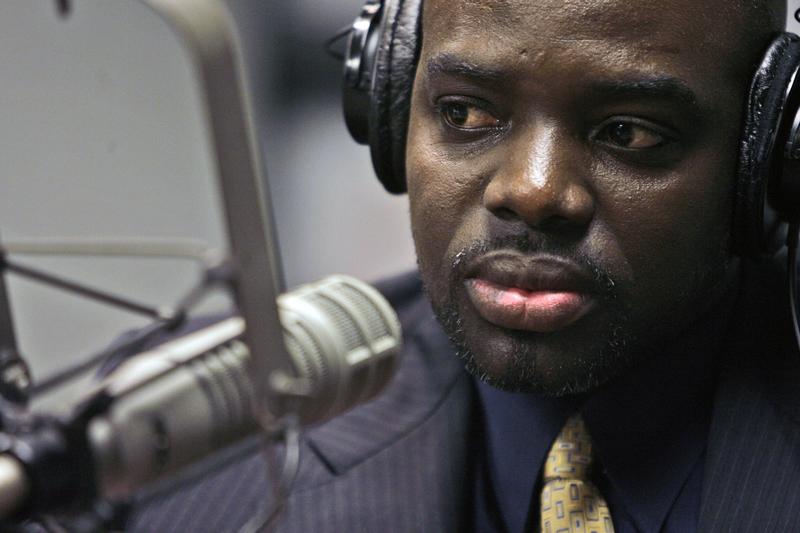
Louima eventually reached an $8.7 million settlement with the city, the largest individual payout for an NYPD brutality case. More than $1.6 million of that came from the police union, which took part in an attempted cover-up. The city got the union to end the so-called 48-hour rule, which gave officers two days to get their stories straight before talking to investigators. More recently — following a grand jury's decision not to prosecute the officer who put Eric Garner in a fatal chokehold — Governor Andrew Cuomo enabled the state attorney general to act as an independent prosecutor in certain cases involving police attacks on civilians. It's something Louima called for many years ago.
Louima now lives in Florida with his wife and children and runs a real estate business. He did not return WNYC's phone calls for this story. He occasionally speaks out about the deaths of civilians at the hands of police. But he's opted to stay out of the public eye.
Ten years after his assault, he wrote an editorial in the The New York Daily News. He said, "Things may have improved a bit, but not enough."
With production assistance from Mara Silvers and Wayne Shulmister, as well as Andy Lanset and Marcos Sueiro Bal of WNYC’s Archives. Other archive audio courtesy of NY1.

WNYC is funded by sponsors and member donations