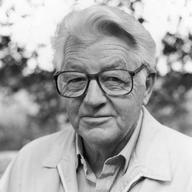
Wallace Stegner and the Art of Fiction
In this 1988 lecture,* Wallace Stegner (1909-1993), one of the heavyweights of 20th Century American letters, talks about his long journey as a writer and the process of creating fiction. His novels earned him the 1972 Pulitzer Prize for Angle of Repose and the 1977 National Book award for The Spectator Bird, but he also wrote short stories, histories, biographies and essays. His subject matter was largely people and places of the American West, particularly California and Utah. He relied extensively upon material from his personal life for his fiction, including his first novel, Big Rock Candy Mountain, published in 1943.
Although Stegner later founded Stanford University’s esteemed Creative Writing Program, as a novice he was hopeful that there was a way to learn the process of writing. He remembers taking a course in the 1930’s entitled “How to Write a Short Story, Though Ignorant.” Stegner describes a creative writing teacher who treated the craft as akin to carpentry, a process by which stories are made not born or discovered, where the circumstances of a tale “had to fit a Procrustean Bed” of tried and true narrative technique with characters in conflict and readers’ expectations reversed.
“Beginners and hacks pay more attention on how to write than what they should write,” says Stegner. But he claims that writing from a blueprint does not allow for passion, “illuminates nothing and leaves no wonder in the reader’s mind.” While he admits that faithful application of the writing rules contained in George Polti’s literary rubric “Thirty-Six Dramatic Situations” might achieve results in the right hands, such formulas did not suit him. The best fiction writers – Chekhov, Kafka, Joyce, Hemingway -- are more sculptors than carpenters, striving for epiphanies and revelations. He advises beginning writers to “take something that meant a lot to you, that you brooded about, and try to see it as clearly as you can.”
Disagreeing with Stendhal, Stegner did not see a writer’s purpose as precisely mirroring reality. He believed a writer functioned more as a lens than a photocopier, illuminating reality with his or her own viewpoint. Such fiction “contains the astigmatisms of its maker,” portraying what is uniquely important to the writer.
While acknowledging that the fragmentary styles of modernist writers like John Barth or Thomas Pynchon can open new doors to viewing reality, Stegner considered himself more of a realist. He was not averse to innovation in style but only if it served to “make everyday life memorable.” Furthermore, unlike many avant-garde writers, Stegner had no solid family background or overbearing cultural traditions he wanted to declare his independence from. Rather than be a loner, he wanted to belong to the common life around him.
The renowned foreign correspondent, Martha Gelhorn, complained that Stegner’s portrayal of quotidian lives of mostly Western Americans did not interest her. She urged him to seek adventures in the world and place himself into new environments. But he saw that as “slumming” --- an effort to seek experience in order to develop something new, when what he needed as a writer was already around and within him.
For Stegner, the real world exists and literature imitates it. The necessary raw material for his work are the places and people he knows, including his family, which lived an itinerant, hard-scrabble life in Montana, Saskatchewan and Salt Lake City. Not surprisingly, his fiction is often described as semi-autobiographical. Stegner makes no apologies for this. Like John Cheever, he “wrote to make sense out of his life” because “an unexamined life was not worth living.”
Since novelists are so prone to drawing from their lives, Stegner says that few of them write autobiographies. The story of their lives – Philip Roth’s, for example -- has been told in their work. But he also notes that, paradoxically, that a writer’s remembrances used when making either fiction or autobiography are often really “factions”, embellishments of reality due to the imperfection of memory. “Mark Twain often said he remembered a lot of things very clearly that never happened.”
Ultimately, Stegner views the writer as on a quest to be receptive, skeptical and watchful, like a photographer of found objects shedding indirect light on a subject to see it at a different angle and thus develop something new. His ultimate advice: “See the thing as clearly as you can and try for the clearest, least obscured image,”
___________________________________________
*Broadcast over WNYC as part of the Voices At the New York Public Library series on May 30, 1993.

WNYC is funded by sponsors and member donations