WNYC Director Morris Novik's Tribute to Mayor La Guardia
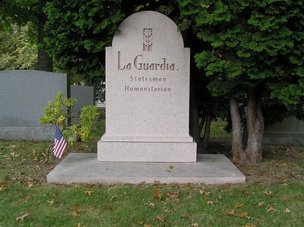
On September 20, 1964 at Woodlawn Cemetery in the Bronx, a memorial ceremony was held marking the 17th anniversary of Mayor Fiorello H. La Guardia's death. Former WNYC Director Morris S. Novik paid tribute to his old boss and the role La Guardia played in making WNYC the nation's leading public radio station. The following is a transcript of his remarks*
On this, the 17th anniversary of the death of Fiorello H. La Guardia, we assemble as we have done every year to pay tribute to a man we loved. As the years go by, each of us attempts to assess the man. We try to explain the imprints he made, not only on our lives in general, but also on our personal lives. The legacy of La Guardia was his identification with the people; they loved him and he loved them.
Each of us, as the years go by, see Fiorello La Guardia, naturally enough, through his own eyes. Objective though we try to be, we cannot but think in terms of our own personal relationship with him. All of us knew La Guardia as a great man, as a great mayor, as a great leader. It was my fortune to know La Guardia as a great communicator.
There are many explanations for the La Guardia phenomenon. One seems to dominate. He was able to talk to the widest audience and not only be heard, but understood. His phrase was not elegant. It often was not eloquent, but it was always direct, earnest, and completely understandable. It was as though his heart had a tongue that spoke to other hearts. This understanding was not limited to any one group. It reached everyone.
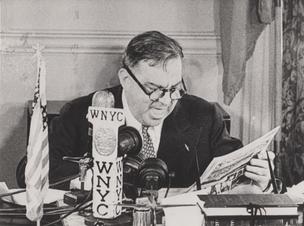
La Guardia pioneered in the use of radio. He understood that It was not merely a medium for making speeches. It was to him, a medium for talking personally with real people about real-life problems. He talked to people about their problems in their own terms. When he talked about the price of tomatoes on radio, be wanted to help people with limited earnings to make every penny count. He was trying to help them live better and more rewarding lives. Radio helped him ring each doorbell, talk with each person, and help every one of them with the problems of everyday living. This personal recollection of La Guardia is more than a sentimentalized memory. La Guardia saw radio, and in his last years, television--as practically an extension of personal conversation. Many did not agree with La Guardia but they always listened.
WNYC was in existence for many years prior to Mayor La Guardia taking office. In many ways, It was regarded as an orphan or stepchild of the city government. In fact, previous administrations literally hid its antenna behind the statue on top of the municipal building and assigned the station to the housekeeping agency of the city, concerned with maintenance of buildings and bridges--the department of plants and structure.
It was Mayor La Guardia who first recognized the value of a city radio station. It was he who was responsible for the establishment of the radio station as an independent municipal department. Then began the long-range campaign to establish WNYC as a vital force in the affairs and lives of the people of the city of New York. This led into the prolonged struggle with the Federal Communications Commission to obtain recognition for the unique services rendered by WNYC and for its right to have full time on the air. A major step in winning that battle was actually achieved only recently, 26 years later. Hopefully, the final victory will not be long in coming.
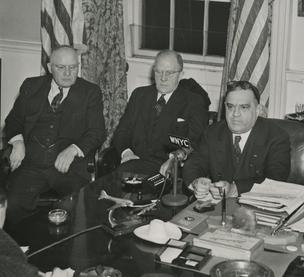
During the crucial years of World War II La Guardia saw radio as a personal line of communication between government--local government--and the people. From day to day the people wanted to know not only about the events of the day, but how those events were evaluated by someone they trusted. They trusted Fiorello La Guardia. When the war broke out in 1941, the mayor was the first to realize the importance of radio and WNYC in supporting the war effort on the home front, in civil defense, and in keeping people informed of where and how they could help.
Mayor La Guardia never missed a Sunday broadcast during the war. In the heat of summer--and City Hall was not air-conditioned in those days--and in the dead of winter, Fiorello La. Guardia left his home to face the WNYC microphone and press every Sunday to report to the people of New York on city affairs and the contribution the city was making to the war effort.
He reported how and where they could help, when to collect tin cans, what changes were being made in rationing, how to conserve vital energies needed for the war effort. He told them of what he thought about everything connected with the war effort. He lifted high the hope and strengthened the courage and the morale of the people of the world's greatest city. Just as the bells of the Tower of Parliament inspired the beleaguered people of Great Britain, so WNYC broadcast the historic chimes of our City Hall, followed by the identification "WNYC in a city where over 7 million people live in peace and enjoy the benefits of democracy."
La Guardia wanted the station to be a living service to the city. He wanted it to draw the people closer to each other and to their city. He wanted it to help, to teach, to entertain, to serve, to unite--and to continue. Regularly during the war, the civil defense programs and services of WNYC were transmitted to the commercial stations in the city for rebroadcast. WNYC was the keystone in the arch that never cracked security during almost four years of voluntary censorship and self-regulation. Many are commemorated by statues, monuments or public facilities named in their honor such as airports, bridges, and tunnels.
While one of the great New York airports bears his name, I prefer to think that Mayor La Guardia's principal monument is radio station WNYC. The station established a standard of excellence and a code of public service for broadcasting that even today is still unique. The station still plays a leading role in the cultural and civic affairs in the city.
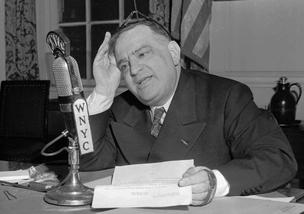
That is the monument on the ether waves to Fiorello La Guardia. It is a voice that still speaks long after its innovator has passed from us. It is a voice that has meaning and responsibility. It is listened to because of its authority. It is a living thing, a monument to his patience, his fortitude, his fighting spirit. Perhaps I have spoken too much about La Guardia's great contributions to WNYC and the field of communications. That is natural for me. On this the 17th anniversary of his death, I know that all of us here feel his presence. We still miss him for his concern with a hundred causes. We miss him as a man. We miss him as a friend. He was sometimes difficult. He was sometimes violent. He could be gay. He could be sad.
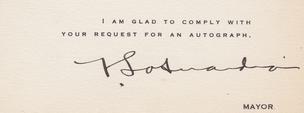
Fiorello La Guardia is missed, and he will never be forgotten.
______________________________
You can listen to Mayor La Guardia's weekly WNYC program at: Talk to the People.
In addition, we've posted many addresses in and around the city at: Mayor La Guardia.
*Source: Senator Jacob Javits (R-New York) placed Novik's remarks in the September 29, 1964 (pages 23033-23034) edition of the Congressional Record published by the U. S. Government Printing Office.
Editor's Notes: I would be remiss if I didn't provide some additional information and context to these remarks. Mayor La Guardia was indeed a champion of WNYC but that wasn't always the case.
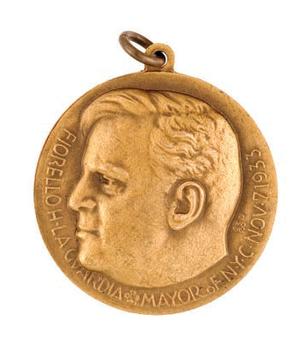
1) When running for Mayor in 1933 part of La Guardia's campaign platform included the elimination of the station to save taxpayer money. Following his election, among his first actions was to send Seymour N. Siegel over to the Municipal Building to shut the station down. Fortunately, Siegel, and I imagine a few others, convinced him to look into the matter more carefully, and, to his credit, he did. A committee of 'experts' was impaneled to assess the station and make recommendations.
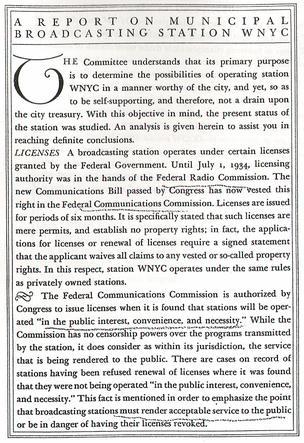
2) The committee, composed of network executives William S. Paley (CBS), Richard C. Patterson (NBC), and Alfred J. McCosker, (WOR/Mutual Radio), essentially concluded the station was worth keeping if reforms were made. Their report coincided with the depth of the economic depression and the Roosevelt administration's launching of the various WPA programs. This allowed La Guardia (and Siegel) to begin to turn the under-performing station around largely at federal government expense while putting unemployed New Yorkers to work. Under the WPA, a significant amount of airtime was filled by the Federal Music Program musicians and Federal Theater Program-Radio Division actors. The Federal Art Program underwrote the cost of six abstract murals and a sculpture (although only four were completed and hung). And finally, under the WPA, new studios were built in the Municipal Building and a state-of-the-art transmitter facility was established in Greenpoint, Brooklyn.
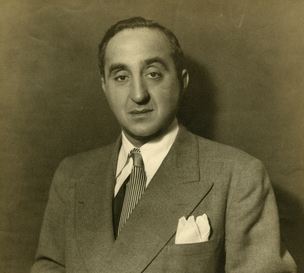
3) La Guardia's hiring of Morris S. Novik in 1938 was indeed a significant vote of confidence for the station and its potential service to the city and its residents. Novik had proven himself an energetic innovator at WEVD and was well connected to labor and progressive movements in the city. By that point too, La Guardia well understood the power of the medium and what it could do for his political and social agenda. It was no accident that 1938 also saw the creation of The Municipal Broadcasting System, an agency reporting directly to the mayor.
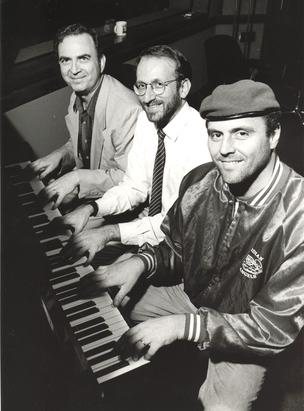
4) Mayor La Guardia, like his predecessors and successors, was often accused by critics of using WNYC for partisan political purposes. Indeed, there is no doubt that mayors from John Hylan to Rudolph Giuliani did, at times, use WNYC for partisan political advantage. Some were more heavy-handed than others. When a government or governmental entity owns or controls a broadcaster, it's nearly impossible to avoid direct or indirect editorial influence. And even if it isn't the case, the perception is almost always there, making a good argument for the broadcaster's independence. For more on WNYC's trek to freedom, please see: Going Public: The Story of WNYC’s Journey to Independence.
5) For more on Novik and Siegel, the two men who helped Mayor La Guardia make WNYC an archetype of public broadcasting, please see: "Under Two Visionary Directors, New York’s WNYC Became An Incubator of Pubmedia Innovation."

WNYC is funded by sponsors and member donations