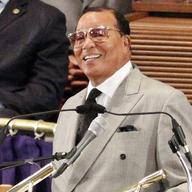
Women's March Organizers Face Backlash for Links to Farrakhan
Half of the board of the Women's March organization is facing criticism for its alleged alliances with Louis Farrakhan, the Nation of Islam leader who delivered a virulently anti-Semitic and bigoted speech in Chicago last month.
The speech was attended by Tamika Mallory, co-president of the Women's March organization and a prominent activist in New York City who served on the transition team for Mayor Bill de Blasio. Farrakhan mentioned her from the podium, and Mallory posted a video from the event on Instagram.
Farrakhan's three-hour speech before thousands of followers also featured a few misogynistic and anti-white comments, but he repeatedly turned to the Jews, the object of his ire for decades. "The powerful Jews are my enemy," he declared. Farrakhan alleged that Jews are responsible for "all of this filth and degenerate behavior that Hollywood is putting out, turning men into women and women into men."
"The white folks are going down and Satan is going down, and Farrakhan...has pulled the cover off the eyes of the Satanic Jew, and I'm here to say your time is up, your world is through," he said to applause. He alleged that Jews run Mexico before listing countries where Jews live. "Everywhere they are they take on the language, the culture — but they run the money, they run the business," he said.
He added: "I know all of you got Jewish friends. I got some too. But when you know them and you're not afraid to say who they really are, they move to destroy you."
After revelations surfaced of Mallory's attendance she was criticized by the Anti-Defamation League and Jewish writers who otherwise support her feminist causes. Mallory responded with a series of tweets that denounced anti-Semitism but did not address her connection to Farrakhan. Two other New York-based board members of the Women's March — Linda Sarsour, a well-known Muslim and immigrant rights activist, and Carmen Perez, an advocate for civil and human rights — then took to social media to support Mallory. That triggered even more backlash.
On Tuesday, the Women's March twitter feed put out a statement attributing its "external silence" to ongoing "conversations" in order "to create space for understanding and healing." The statement also said: "Minister Farrakhan's statements about Jewish, queer, and trans people are not aligned with the Women's March Unity Principles." The statement did not include an apology or denouncement of Farrakhan that many commenters on social media were seeking.
Neither Mallory, Sarsour or Perez have specifically addressed the Farrakhan controversy, and they did not return WNYC's emails to them and their representatives.
Alleged ties between Farrakhan and these Women's March leaders go back several years. Mallory and Perez were pictured with Farrakhan in 2015. The following year, Sarsour spoke at an event that Farrakhan participated in. Mallory posted a happy birthday message to Farrakhan last year, and in 2016, Perez's Instagram photo with Farrakhan got this comment from Sarsour: "the brother does not age. God bless him."
Most recently, in a January article on Refinery29, Perez defended Farrakhan: "People need to understand the significant contributions that these individuals have made to black and brown people," she said. "There are no perfect leaders."
While the media focus on the resurgence of anti-Semitism since the 2016 election has largely centered on the white supremacist alt-right and how some Republicans seem increasingly comfortable with it, Farrakhan's allies in the liberal and Democratic establishment have largely been overlooked.
A 2005 photo recently surfaced of Barack Obama, then an Illinois state senator, standing next to Farrakhan. A year later, four Democrats in the Congressional Black Caucus met with him. And just last week, U.S. Rep. Danny Davis of Illinois told the conservative Daily Caller:
"I know Farrakhan, been knowing him for years and years and years and years and years, and every once in a while some writer or somebody will I guess try to think of something to say about Farrakhan, but nah, my world is so much bigger than any of that. I don’t have time for that. I deal with it, you know, when it comes but nah, that’s not a real part of my focus...That’s just one segment of what goes on in our world. The world is so much bigger than Farrakhan and the Jewish question and his position on that and so forth. For those heavy into it, that’s their thing, but it ain’t my thing."
The three Women's March board members did not make the bigoted comments themselves, but their unwillingness to explicitly denounce Farrakhan's comments could continue to alienate some of their supporters. It also seems to conflict with how they have sought to make the movement "intersectional" — supporting equality for those of all backgrounds under the umbrella of feminism. Sarsour, in fact, raised thousands of dollars last year to rebuild Jewish cemeteries damaged in anti-Semitic attacks.
Though he has receded from the headlines in recent years, Farrakhan is still "the most popular anti-Semite in America today," according to the Anti-Defamation League. Consider that on Monday, Richard Spencer — the face of the alt-right movement and a constant target of media attention — drew fewer than 50 people to a major speech. Farrakhan, meanwhile, filled a 10,000-person arena last month.

WNYC is funded by sponsors and member donations