On-Demand Video: World Premiere of John Luther Adams's Sila: The Breath of the World
Friday, July 25, 2014, a crowd of over two thousand spectators gathered in Lincoln Center's Hearst Plaza, stretched out on the pavement around the center's central pool. A vendor sold gelato, a helicopter buzzed overhead and the sounds of New York City – car horns, incessant chatter, distant music – echoed off of the walls of the surrounding buildings. It was the setting for the newest composition from Pulitzer Prize-winning composer John Luther Adams: Sila: The Breath of the World.
Lincoln Center, which commissioned the piece for the festivals of Mostly Mozart and Lincoln Center Out of Doors, has just released with the help of Adams and music director Doug Perkins, a video of the performance, which can be seen below.
Watch the complete performance: (Addition: Due to the nature of the audio editing/mixing, John Luther Adams recommends listening with headphones or high quality speakers.)
Any classical music fan who's had their ear anywhere near the ground lately knows the story of John Luther Adams. Originally from New Jersey, the composer has spent the better part of four decades writing on the edge of the Alaskan wilderness, his music often inspired by the processes of the natural world.
For Sila, the environment was not only a source of inspiration; it was an integral part of the music itself. In Adams's own words: "In Inuit tradition the spirit that animates all things is sila, the breath of the world. Sila is the wind and the weather, the forces of nature. But it’s also something more. Sila is intelligence. It’s consciousness. It’s our awareness of the world around us, and the world’s awareness of us."
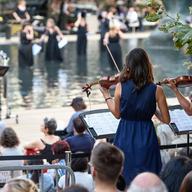
The piece brought together 80 musicians from a healthy handful of accomplished ensembles, most of them from the New York area. Singers draped in black robes waded through the square's center pool. Brass and woodwinds lined a hill about 50 feet back. String players gathered under the shade of trees and percussionists armed with timpani and found objects lined the pool's periphery.
Like much of Adams's work, the music unfolds slowly, each musician moving at his/her own pace through a sequence of harmonic "clouds," their sustained notes dictated by the lengths of their respective exhalations. What begin as disparate, pointillist entrances gather into hazy, ambient textures; melodic fragments emerge from the singers and horns, drifting freely in the wind.
Almost immediately upon the music's start, the sounds of the city and instrumentalists blended together so seamlessly that it was difficult to differentiate a distant trombone from a car horn, percussionists rubbing together sand-papered blocks from pedestrian footsteps. And by the time a few minutes had passed, that distinction became irrelevant, sila and music indistinguishably intertwined.
The performance featured members from Asphalt Orchestra, Cadillac Moon Ensemble, Contemporaneous, The Crossing, Eighth Blackbird, Face the Music, Grand Valley State University New Music Ensemble, Hotel Elefant, JACK Quartet and TILT Brass.

WNYC is funded by sponsors and member donations