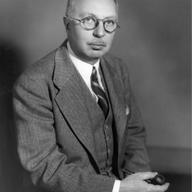
WQXR Co-Founder and Radio Pioneer John Vincent Lawless Hogan
Listening to WQXR co-founder John V. L. Hogan (1890-1960) in the above radio address, made only a few months after W2XR became WQXR,* one is struck by just how important feedback (pun intended) was to him. Radio was still an evolving media and the listener's point of view was critical to its forward movement. In the address, Hogan emphasizes that WQXR was different and not content or "self-satisfied" with status-quo --either technically or programmatically. He urges listeners to write in about a variety of issues: the station's placement of "more restful" classical music over jazz at the bedtime hour; when and how they should announce or not announce the title and author of works; whether their efforts at developing advertising that's "a service and not a nuisance" are succeeding; and the running of a series of audio level and mixing tests over the air.
Historically, the somewhat understated Hogan tends to be overshadowed by his more outspoken business partner Elliott Sanger. Together in 1936 they created the Interstate Broadcasting Company, the parent of WQXR, radio's first commercial classical music station. Sanger, a former advertising executive, wrote the well-publicized 1971 history of the station, Rebel in Radio: The Story of WQXR, and was usually the spokesperson for the station. Hogan was the author of a 1923 electronics classic, The Outline of Radio, and the technical genius behind radio's leading "high-fidelity" broadcaster.
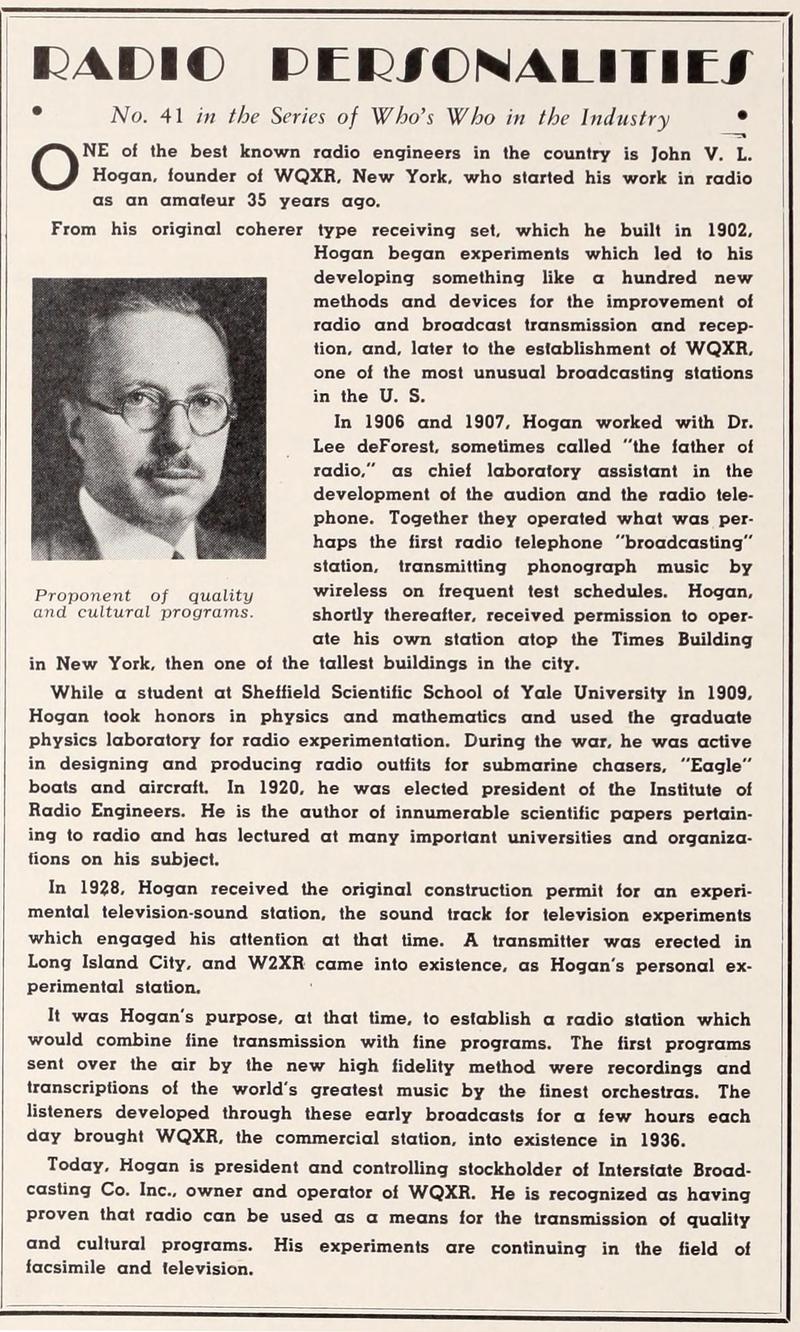
Nevertheless, even when WQXR was still in its infancy, Hogan had been long recognized in the trades as an innovator and pioneer in broadcasting. Radio Daily published the following profile and tribute to him on June 6, 1937.
In 1956, the Institute of Radio Engineers (IRE) awarded its Medal of Honor to John V. L. Hogan. He was cited “for his contributions to the electronics field as a founder and builder of the organization." The citation also noted his inventions and "continued activity in the development of devices and systems useful in the communications art.” Hogan was the father of single dial radio tuning and made other significant contributions to the field through WQXR. He also pioneered facsimile transmission via radio, and advanced developments in television, radar, and military communication systems. He died in Forest Hills, Queens on December 29, 1960.
________________________________________
*Note: Hogan made the above broadcast over WQXR on March 1, 1937. W2XR became WQXR on December 3, 1936.

WNYC is funded by sponsors and member donations