
95% Property Tax Break Paid for by You, Enjoyed by Billionaires
A property tax abatement program set to expire in June is responsible for enabling tax cuts of 95 percent this year for condo owners at 157 West 57th Street. The program offers similar breaks to thousands of dwellings throughout New York city.
The program, called 421-a, is administered by the city, and approved by state law. It was created in 1971 to spur building in a near-bankrupt New York City. It's morphed over the years to require developers who take advantage of it to also set aside 20 percent of their units as affordable housing in some parts of the city.
Builders who use 421-a receive significant tax abatements on properties for up to 25 years. In the initial years of the abatement, buildings can receive 100 percent off their tax bill for the current assessed value of the property. These buildings, however, do pay some property taxes based on the assessed value of whatever was on the property before the new building was constructed.
"Under the 421-a law, in the 100 percent years, a new building pays on the assessed value in the year before commencement of construction of the building. So the exemption is equal to the increase in value between the old assessment and the new building," said real estate attorney Paul Korngold with Tuchman, Korngold, Weiss, Liebman & Gelles.
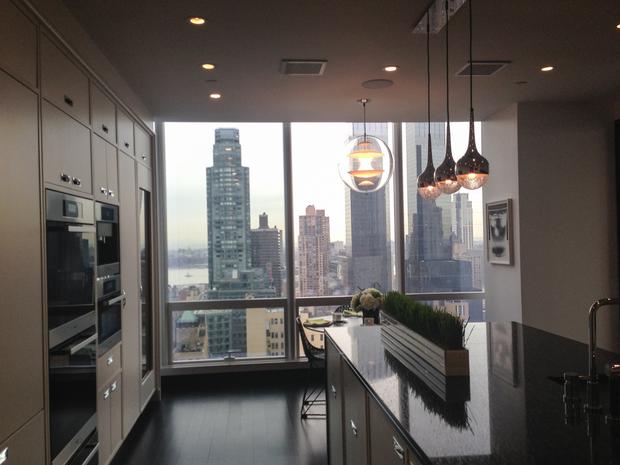
While developers say 421-a is essential to new construction in New York City, the program produces significantly more market rate housing than affordable apartments, and in some cases has made it more difficult to create affordable housing in desirable neighborhoods.
"Tenants in Hells Kitchen hate this program," said Sarah Desmond with Housing Conservation Coordinators, a tenants' rights group that helps residents on the west side of Manhattan. "The incomes of the people who are eligible for the [affordable] apartments don't respond to where the need is in our community. It's a significant tax break for something that produces such a small amount of affordable housing in our district."
Developers who build with 421-a will sometimes tear down a building where affordable apartments might already exist, thereby displacing tenants. Additionally, in some instances, developers using 421-a can build the required affordable units offsite. Advocates complain that can suction even more affordable units from desirable neighborhoods.
"The affordable housing is built in another borough, so as a community we lose the resource of getting any affordable units. That creates a polarization in the neighborhood of two different cities, two separate communities," said Desmond.
This winter, more than a hundred advocates protested outside of 157 West 57th Street, a building that has come to symbolize all the problems associated with the 421-a program.
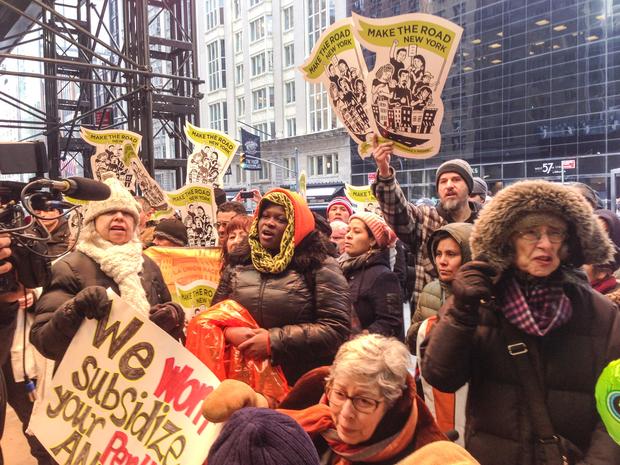
The building's developer, Gary Barnett, didn't actually produce any affordable housing to get the tax break. Instead, he bought what are known as negotiable certificates from another developer who did construct affordable housing. That developer, Peter Fine with Atlantic Development, had built apartments on Jessup Avenue in the Bronx in the mid-2000s. As a part of that development, Fine received tax credits in the form of certificates that he sold to Barnett.
The negotiable certificate program was eliminated in 2008, though certificates still in existence at that time can still continue to be sold. The de Blasio administration is considering reviving the certificate program in some form.
As an example of how valuable the benefit is to condo owners at 157 W. 57th St., unit 32B will pay real estate tax of $2,160 for 2014-2015. If there had been no 421-a benefit this year, the condo unit would have paid an annual real estate tax of $47,091.20.
Both Gary Barnett and Peter Fine did not respond to requests for comment about their 421-a deal.
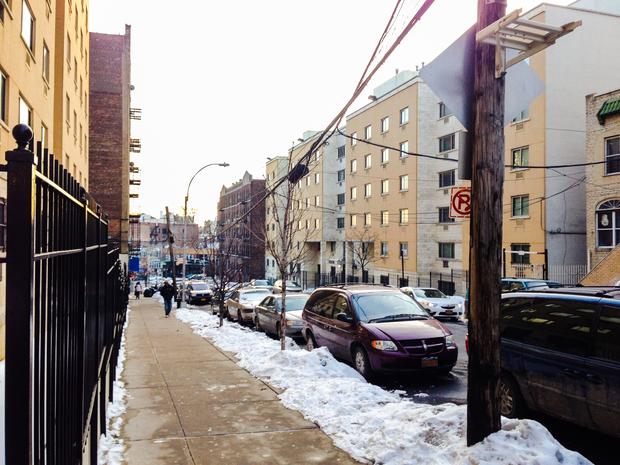
While a far cry from the luxury of 57th Street, the buildings on Jessup Avenue with their brick facades offer affordable units to hundreds who need housing.
"The neighborhood is alright, but the building, the apartments are really nice inside," said resident Tomas Alcancara. He added that residents are thankful for the relatively inexpensive accommodations.

WNYC is funded by sponsors and member donations