You Have to See These Unusual Performances of La Monte Young's 'Compositions 1960'
Performers of the minimalist music pioneer La Monte Young’s Compositions 1960, a series of works composed during that year, confront an eclectic shopping list: a fire, a butterfly (but any number will do), a bale of hay and a bucket of water (with which to feed the piano), possibly a whirlpool.
Materials assembled, there is then the matter of what to do with Young’s instructions, one per composition. A few of the compositions are more easily incarnated than others. “Composition #6” requests that the performers sit on the stage, watching the audience as audiences are taught to watch performers.
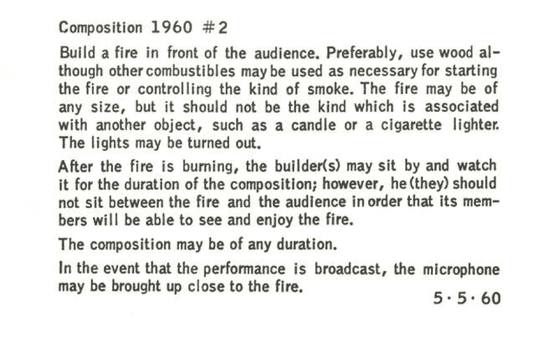
Some compositions require caution.
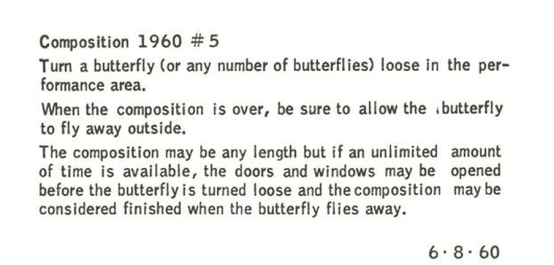
Others, patience.
“Composition #10” is a shrug and a wink.
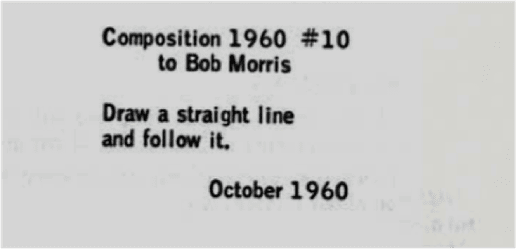
#10, like all of the compositions, is open to interpretation. Here is one:
“Composition #7” is perhaps the most popular. It is the only one to require specific musical notes.
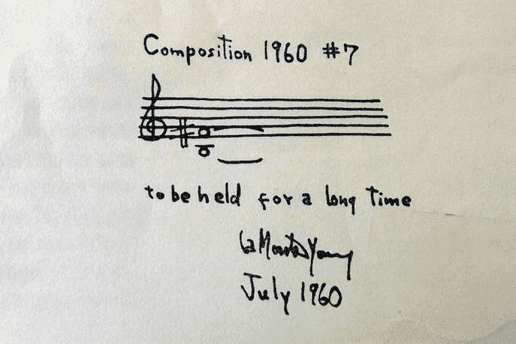
Here it is performed on a piano:
... and on a few other instruments.
Born in 1935 in a log cabin in Idaho, Young was raised by his father, a Mormon sheepherder. His first memories of sound were of the wind blowing through the cabin and, outside, the grasshoppers, which make an appearance in the composition titled “Piano Piece for David Tudor #3.”
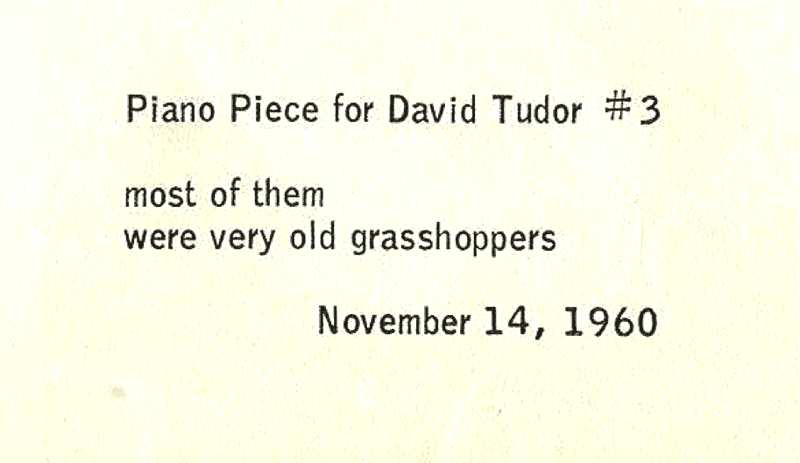
(Also up for interpretation.)
Young’s father and his aunt, a rodeo performer, introduced him to music, and he went on to pursue a graduate degree in composition at UC Berkeley. His formative musical experiences were with jazz, serialism, and Indian classical music. Cage’s philosophy of chance and indeterminacy, which Young learned about in a lecture by pianist and composer David Tudor at the Darmstadt International Summer Courses for New Music in 1959, also proved profoundly influential, and jumpstarted his work on Compositions. In a 2003 interview for New Music Box, Young also described Compositions 1960 as a “sociological reaction” against Berkeley, whose academic environment Young found restricting. In 1960, Young flew to New York to study with Cage and Richard Maxfield, and premiered some of the Compositions at Yoko Ono’s loft.
Around this time, he also presented some of his experiments, as well as work by Cage, Maxfield, and others, in a series of noon concerts at Berkeley that “kids were nowhere near prepared for.” “It was at that point ... that I began to realize how easy it is to manipulate an audience,” he concluded. Not all were impressed by his latest explorations: at a later performance of one of his works involving sustained displays of friction — dragging a gong against cement, for instance — his parents wept, devastated at the direction their son’s life was taking. Young had only begun to embark on a career that, as he himself has put it, “changed music forever”; Andy Warhol, Catherine Christer Hennix, and Lou Reed are among the many to have cited Young’s work, especially that involving sustained tones at high volumes, as an influence.
Today, Young lives and works in New York City with his partner, the visual artist and musician Marian Zazeela. His definition-defying work — the most notable of which includes the Well-Tuned Piano and the Trio for Strings, both of which draw on his fascination with drones in exceptionally slow motion — is performed worldwide. With Zazeela, he also opened the Dream House on Church Street, which you can visit on Wednesday through Saturday. Other current projects include the Just Alap Raga Ensemble, founded by Young, Zazeela, and their disciple Jung Hee Choi.
Few recorded examples exist of Compositions 1960, the full list of which is here. Perhaps because, for many of them, you had to be there:
Compositions gets audiences to ask questions. What is a performance? Who is performing for whom? How long is long? What is the piano’s relationship to the player? What is the potential in a grasshopper? (What are the fire safety regulations in this performance venue?) As usual, there are no right answers.

WNYC is funded by sponsors and member donations