What a Monopoly importer learned when it tried to make things in the U.S.A.
The board game Monopoly has always taught some important economic lessons: The benefits of owning real estate. The profit potential of railroad mergers. The value of a get-out-of-jail-free card.
Now a special edition of the board game is teaching a new lesson—about how hard it is to make things in the USA.
The game is being marketed by the WS Game Company, which produces most of its high-end board games in China, just like almost every other toy maker.
After getting hit with a seven-figure tariff bill last year, CEO Jonathan Silva decided to see if it was possible to produce a profitable board game in the United States.
He opted for a custom version of Monopoly, pegged to the country's 250th birthday. But the experiment almost didn't pass go. One big problem: No dice.
"We turned over every single leaf trying to find someone who would make 10,000 dice for us in the U.S.," Silva says. "It requires special machinery. It requires investment. And that type of stuff just can't happen on a random Tuesday and be ready in a couple of months."
Silva ultimately had to settle for imported dice.
He was able to find the rest of what he needed domestically, but it wasn't easy. A former Hasbro factory in Massachusetts prints the Monopoly board. A company called Pioneer Packaging makes the tray that holds he Monopoly money. And a small business in Indiana cranked out custom metal game tokens, in all-American shapes like a cowboy hat, a covered wagon and an apple pie.
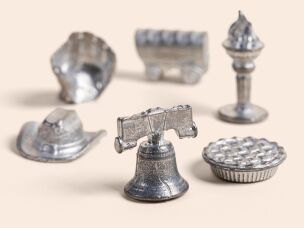
Stateline Industries in Liberty, Indiana fabricated the custom game pieces for the Monopoly Americana edition, with special shapes like a cowboy hat and an apple pie.
WS Game Company
Just assembling all those different players took more than a year, so Silva missed the first half of the 250th birthday selling season. And the cost to manufacture the games — which retail for $80 — was at least double what it would have been in China.
"When I place a purchase order in China, they have all those capabilities under one roof," Silva says. "For one item, it took up way too much of our resources and time to bring it to market."
Why so many things are made in China
There's a reason nearly 80% of all toys and games sold in the U.S. are made in China. That country has spent decades building a factory ecosystem to supply not only finished products, but all the specialized parts that go into them.
"That's why the re-shoring and the looking at bringing it back into the U.S. or even looking at other countries and moving it is not as easy as it sounds," says Greg Ahearn, president and CEO of the The Toy Association, an industry trade group.
Ahearn says it makes sense for the U.S. to manufacture some strategically important products, but probably not when it comes to most toys and games, which tend to carry both low prices and low profit margins.
"Even if you could, who in their right mind would take their capital and invest it into creating a toy manufacturing plant?" Ahearn says. "Of all the things you could pick, we'd probably be pretty low on that list."
Instead, the toy industry is lobbying to get a carve-out from future tariffs. The new U.S.—China Board of Trade is considering allowing up to $30 billion worth of Chinese products to enter the U.S. tariff-free. But toys are competing for the tax break with shoes, apparel and many other products.
For now, Silva is busy marketing his Made in the U.S.A. Monopoly game. But he's still making the rest of his company's board games in China. And that's not likely to change.
"We're really good at a lot of great things here in America." Silva says. "But we're not really great at making certain items that are consumable goods. And that's OK."
He's now awaiting a shipment from China of about $6 million worth of games for the upcoming holiday season. He has no idea what the tariff bill might be. But he's prepared to roll the dice.

WNYC is funded by sponsors and member donations